Cheetah vs. Leopard: Spotting the Difference in the Wild
How can you tell the difference between a cheetah and a leopard?
On this page
You’re on safari, you spot a sleek spotted cat, but is it a cheetah or a leopard? The answer is in the details. This guide will make you an instant expert by focusing on the tells that matter most.
Start With the Face: Tear Marks and Spots
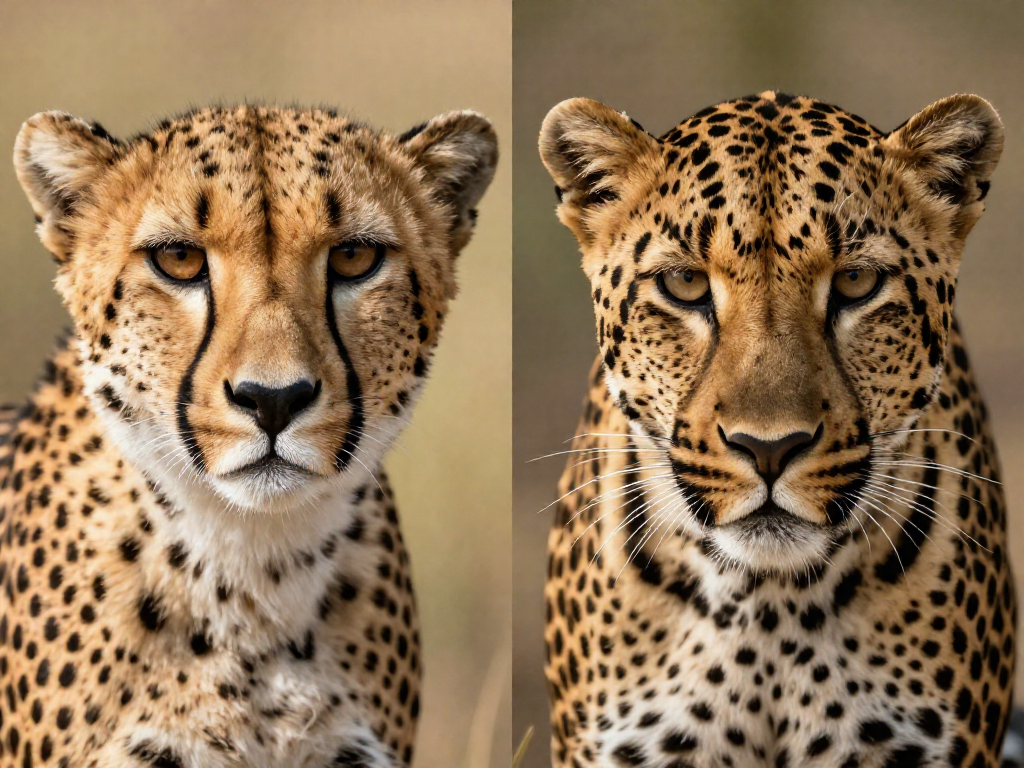
If you want to tell a cheetah from a leopard in a single glance, look at the face. The fastest and most reliable clue is the bold black tear mark that streaks from the inner corner of each cheetah’s eye down to the side of the mouth. Leopards don’t have anything like it. That one feature works whether the cat is sprinting across the savanna, half-hidden in tall grass, or just posing for a photo, and it’s the first thing any guide will tell you.
These tear lines aren’t just a fashion statement; they serve a real purpose. The dark fur helps absorb sunlight, reducing glare much like the eye black athletes wear. As nature photographer Johan Siggesson explains, the marks act as a built‑in anti‑glare system, which is a valuable edge for a hunter that relies on keen daytime vision (Johan Siggesson). Next time you see a cheetah, imagine how much that thin black streak sharpens its view under a blazing African sun.
Once you’ve checked for tear marks, move to the coat pattern. Both cats are spotted, but the spots themselves are a giveaway. A cheetah wears a field of solid, round or oval black dots — evenly spaced, roughly the size of a fingertip, and always distinct. A leopard, on the other hand, is covered in rosettes: irregular, rose‑shaped clusters of dark spots that surround a tawny or slightly lighter center. From a distance, leopard rosettes can look like blotchy, larger markings rather than individual spots. Up close, the difference is unmistakable; there’s nothing solid black about a leopard’s coat — those pale centers are the dead giveaway.
For an even closer look, the eyes provide another layer of identification. Cheetahs have warm amber‑colored eyes, while leopards typically show a cooler, green‑blue tint. This is not as instant as the tear lines, but if you’re viewing a sharp photograph, it’s a nice confirming detail.
Lastly, take in the overall face shape, which reflects each cat’s lifestyle. A cheetah’s face is more rounded, with a short muzzle and noticeably smaller teeth — built for speed, not for brute force. Leopards, in contrast, have a more elongated face and a heavier, more powerful jaw that can hang onto struggling prey and haul it into trees. That stronger jawline might be subtle, but in close‑up images, it’s another piece of the puzzle.
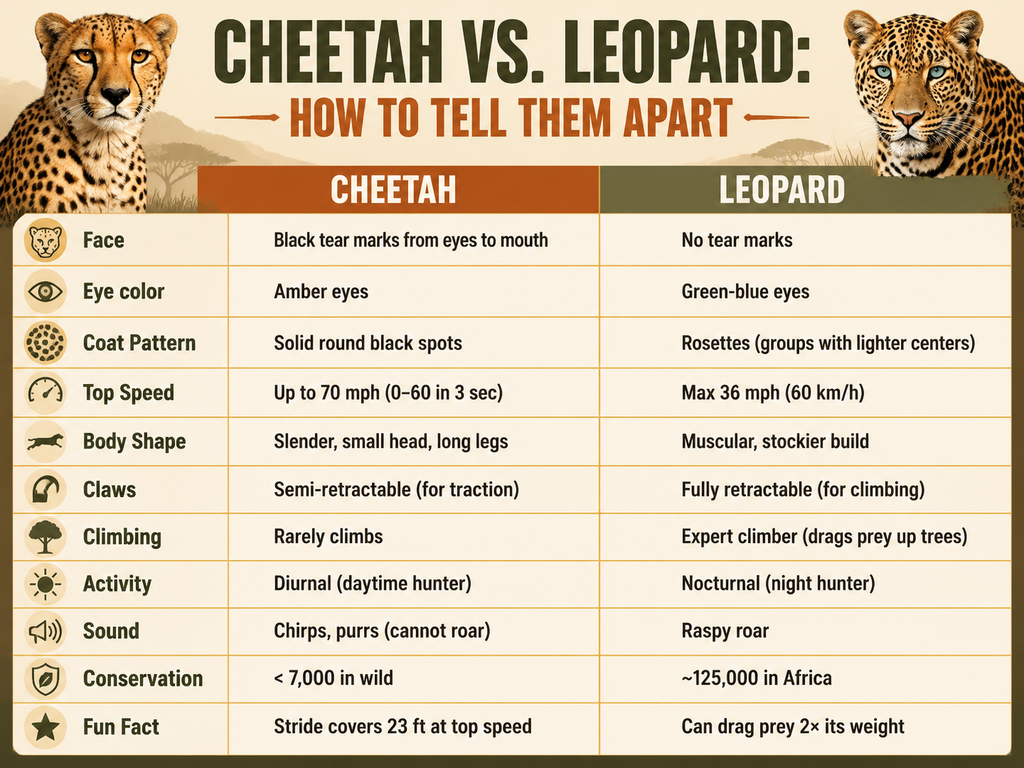
The face tells the story: tear marks, solid spots, amber eyes — cheetah. No tears, rosettes, powerful jaws — leopard. Start there, and you’ll rarely get it wrong.
Body Build: Speedster vs. Powerhouse
Even from a distance, the silhouette tells the story. A cheetah looks like a greyhound in a spotted coat—slender, leggy, with a deep, narrow chest and a surprisingly small, rounded head. Every angle of its frame is fine-tuned for explosive speed. A leopard, on the other hand, is a compact powerhouse. Its body is dense with muscle, especially across the shoulders and neck. The head is broader, the legs stouter, and the whole animal gives off an impression of brute strength rather than raw velocity. In simple terms: cheetahs are built to run, leopards are built to haul.
Look closer at their feet and the difference sharpens. Cheetah claws are only semi-retractable—think of them like a sprinter’s spikes, always partly out to dig into the ground for traction during a high-speed chase. They’re blunter than a typical cat’s claws because they’re constantly worn down. Leopards, by contrast, keep their fully retractable claws needle-sharp inside protective sheaths, unsheathing them for gripping tree bark or snaring prey. This leaves a telltale sign in the dust: cheetah tracks show claw points, while leopard prints are smooth and claw-free (Discover Wildlife).
The tail is another dead giveaway. A cheetah’s tail is wide and flattened, almost like a paddle, and serves as an air rudder during zigzag sprints at 60 mph. A leopard’s tail is more tubular, round in cross-section, and helps with balance when climbing trees. And then there are the feet: cheetahs have noticeably larger back feet, which gives them that extra push-off power, while leopards sport bigger, more formidable front feet designed for grappling and holding onto struggling prey. Once you know what you’re looking for, you can read the whole story of an animal’s life in its body shape alone.
Hunting Styles: The Chase vs. The Ambush
Cheetahs and leopards are built for two completely different ways of getting dinner—once you see it in action, the distinction is almost theatrical. The cheetah is the supreme sprinter of the open grasslands, hunting almost entirely by day, while the leopard is the silent ghost of dusk and dawn, melting into cover for a sudden pounce.
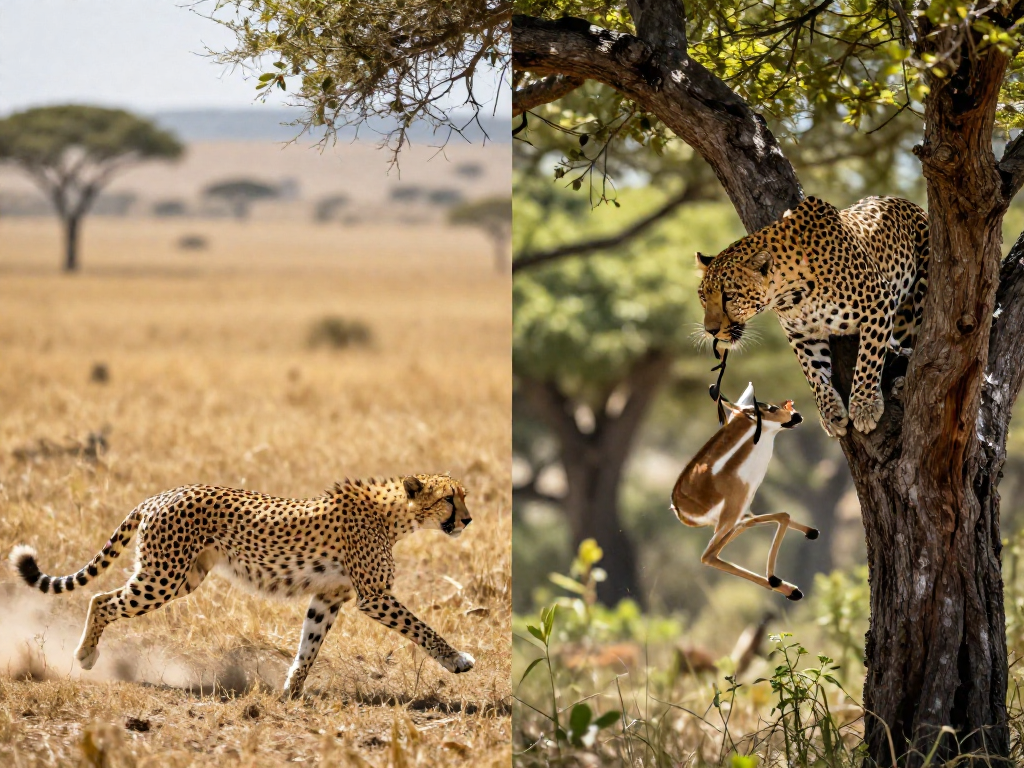
When a cheetah hunts, it’s a high-stakes drag race. It typically begins its pursuit when prey is between 100 and 150 meters away. From a standing start, the cat can hit 60 to 70 miles per hour in seconds—but that blistering pace can only be held for about 300 yards before overheating sets in. In fact, the entire sprint rarely lasts more than 20 to 30 seconds (according to the Smithsonian's National Zoo). If the chase goes longer, the cheetah’s body temperature climbs so fast it must stop, making this one of nature’s most dramatic “all or nothing” attacks. Despite that, the success rate hovers around a surprisingly solid 50%, in part because cheetahs often start so close and accelerate like a rocket. After a kill, though, the exhausted cat is vulnerable—nervous and easily bullied off its meal by hyenas, lions, or even a bold leopard that gets wind of an easy score.
Leopards take an opposite approach: stealth, not speed. Relying on superb night vision, they stalk prey in near-total silence, often inching to within striking distance before exploding from the shadows in a single, powerful leap. Where the cheetah runs the risk of losing its supper to scavengers, the leopard has a trick no other big cat can match. Using immense neck and shoulder strength, it can hoist a carcass twice its own body weight straight up a tree, stashing it safely on a branch to eat later. If you spot a big cat lounging in a tree with a kill draped across a limb, it’s almost certainly a leopard—cheetahs rarely climb, and they certainly can’t haul that much weight.
So, in the field, ask yourself: Is the cat sprinting flat-out in broad daylight across open ground? Cheetah. Is it dragging an antelope up a trunk or moving like a shadow through thick bush? Leopard. The performance gives them away every time.
Social Lives and Sounds: Chirps vs. Rasps
When it comes to company, these cats couldn't be more different. Male cheetahs often form lifelong coalitions—usually with two or three brothers—hunting and defending territory together. Leopards, on the other hand, are fiercely solitary, coming together only to mate.
Their voices seal the ID. Cheetahs are the only big cats that purr, but they can't roar. Instead, they bark, growl, and let out a high-pitched chirp that sounds almost like a bird (Smithsonian’s National Zoo). Meanwhile, a leopard’s call is a raspy, coughing roar—like a coarse saw cutting through wood.
You'll typically spot a cheetah in broad daylight since they hunt by day. Leopards, ever the stealth artists, do most of their stalking under cover of darkness.
Quick Cheat Sheet: Tell Them Apart Instantly
If it has black tear marks, solid spots, and chirps like a bird, it’s a cheetah. Rosettes, a raspy roar, and hauling prey up a tree? That’s a leopard.
Sources
- Cheetah vs Leopard: How to Tell the Difference Between These Spotted Big Cats — johansiggesson.com
- Cheetah vs Leopard: 7 Easy Ways to Spot the Difference — lionstigersandbears.org
- What's The Difference? Cheetah Vs Leopard - Safari Ventures — safariventures.com
- Cheetah Vs. Leopard: Difference Between This Two Wild Animals And Comparison — youtube.com
- Cheetah vs leopard: what's the difference between these beautiful, spotted cats? | Discover Wildlife — discoverwildlife.com
- Leopard vs. Cheetah: Do YOU know the difference? — cedarberg-travel.com
- Cheetah | Smithsonian's National Zoo and Conservation Biology Institute — nationalzoo.si.edu
- Cheetah vs Leopard: How to Tell the Difference Easily – Fahlo — myfahlo.com
- The Cheetah Has Never Reached Such A Speed Before. Amazing Moments of a Cheetah Hunting. — youtube.com
- New insight into how Cheetahs catch their prey | ScienceDaily — sciencedaily.com
See also
- Why Cheetahs Are the Fastest Land Animals
- How Leopards Became Masters of Stealth
- Amazing African Predators: A Family Guide
- Spotted Cats Around the World
Related articles

My Unpopular Opinion: Stop Calling Them 'Killer' Whales
Why should we stop using the term 'killer whale'?
Jul 28, 2026 · 3 min read
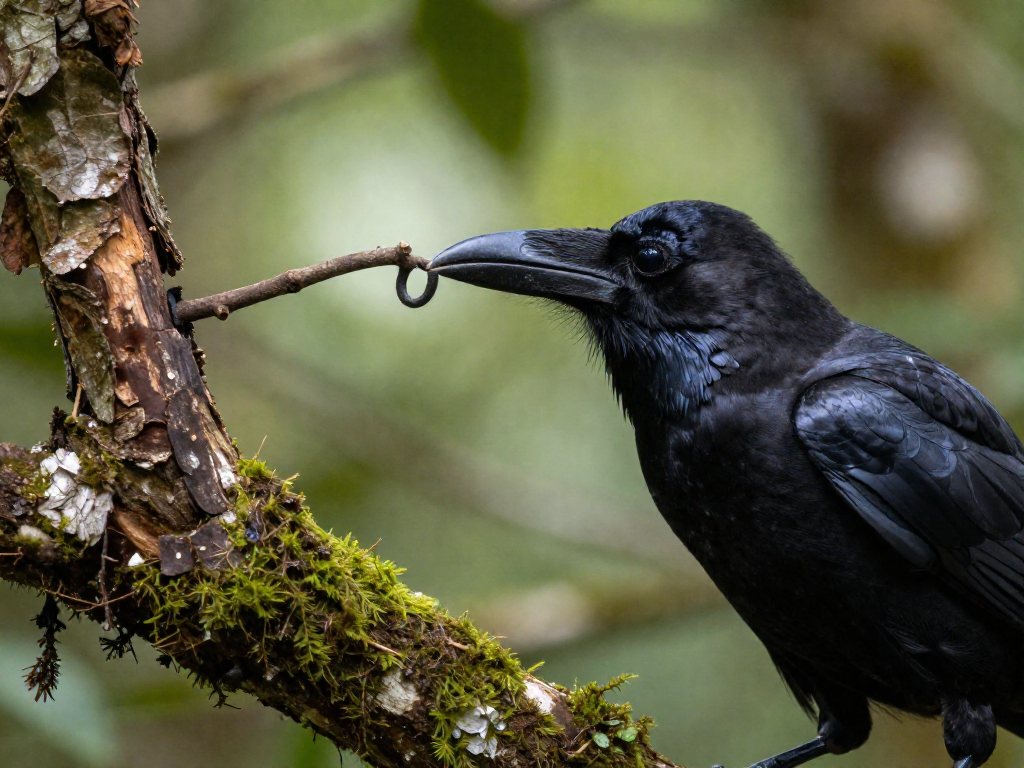
8 Animals That Use Tools (And What They Do with Them)
Which animals use tools, and how do they use them? From crows bending wires to octopuses carrying coconuts, discover 8 tool-using animals.
Jul 28, 2026 · 6 min read
The Secret Life of the Platypus: Australia's Egg-Laying, Venom-Spurred Oddity
Discover the platypus: an egg-laying mammal with electroreception and venomous spurs. Explore its bizarre evolutionary traits.
Jul 20, 2026 · 7 min read