Why Do Birds Sing at Dawn? The Science of the Dawn Chorus
Why do birds sing so loudly early in the morning?
On this page
Hook the reader with the magic and mystery of the dawn chorus, then pivot to the surprising recent revelation that what we thought explained it might be wrong. Preview that the article will explore both the classic and newly discovered reasons.
The Classic Theories: What We Thought We Knew
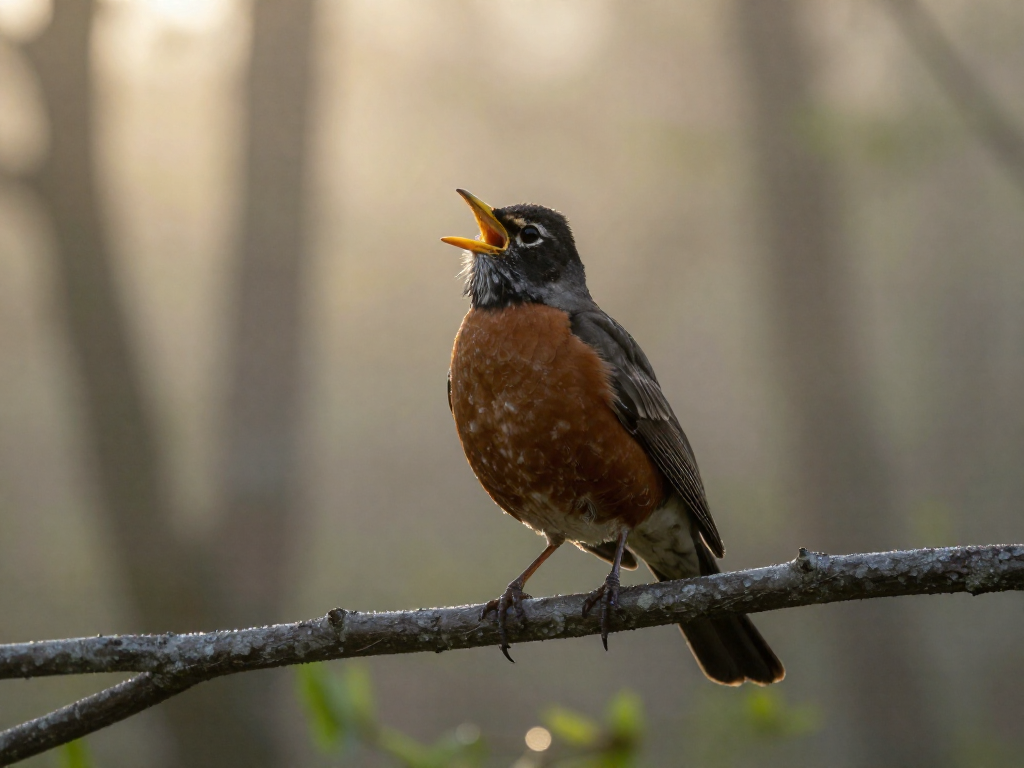
For years, scientists pointed to the morning environment itself: in the still, humid dawn air, sound travels farther and clearer, giving songs more range. Another piece of the puzzle: birds with large eyes—robins can start singing over an hour before small-eyed chaffinches—could literally see better in the dim light, letting them start earlier. Even light intensity was thought to flip the switch.
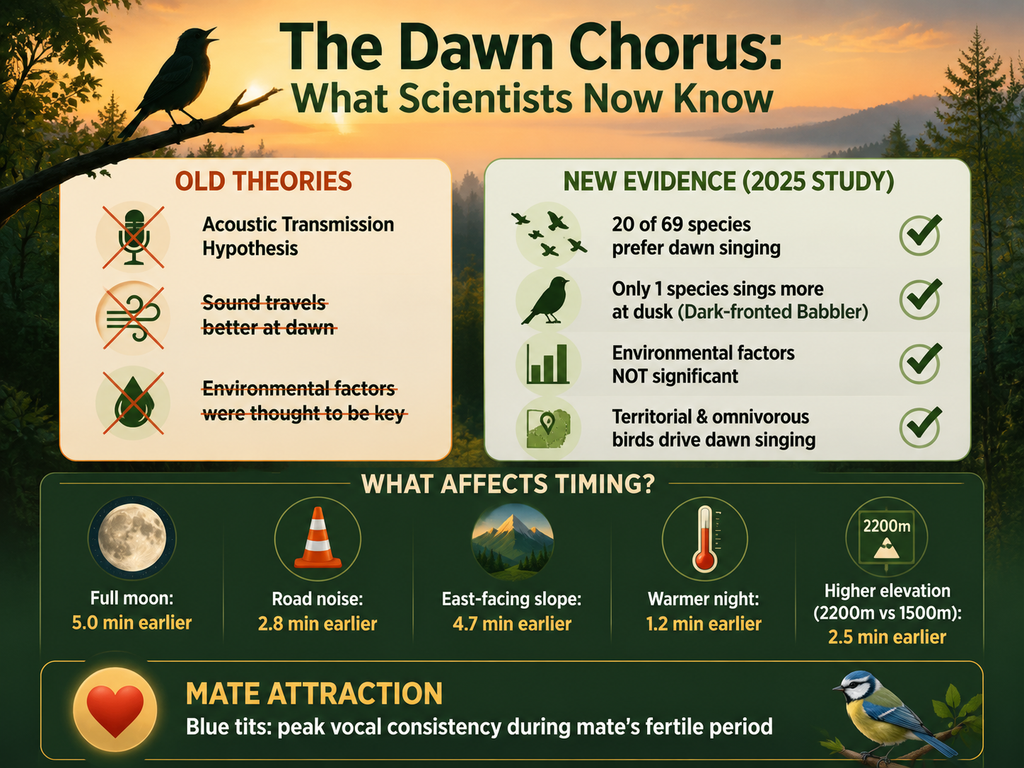
But a landmark 2025 study from the Cornell Lab of Ornithology upset those neat explanations. When researchers examined environmental factors like light levels and sound transmission across an entire tropical bird community, they found no significant influence on dawn singing (Cornell Lab of Ornithology). The old theories still sparkle, but the real reason may be far more surprising.
The Game-Changing 2025 Study: Ruling Out the Environmental Window
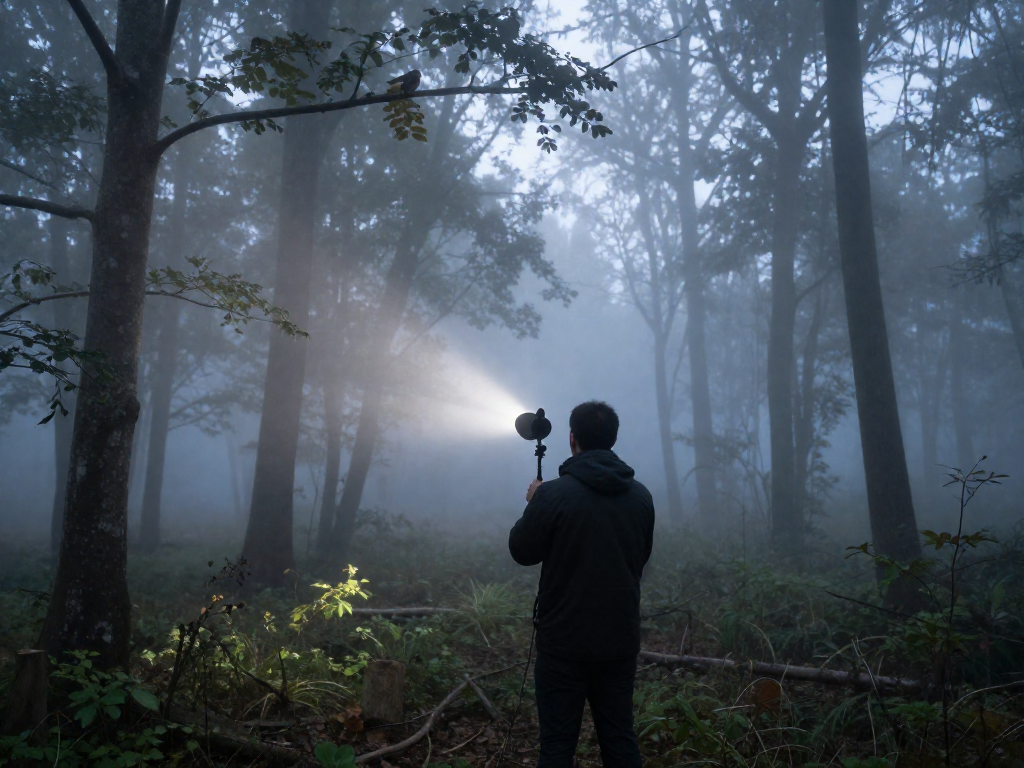
In 2025, a study published in Philosophical Transactions of the Royal Society B blew a hole in the classic explanations for the dawn chorus. Researchers placed audio recorders at 43 sites across India’s Western Ghats mountains and analyzed the vocal activity of 69 bird species. Their first finding: 20 of those species sang substantially more at dawn than at dusk—so the dawn chorus is real. But when they investigated why, the old theories crumbled.
If the “open window” idea were correct, birds with higher-frequency songs should have been especially active at dawn, because those frequencies supposedly benefit more from the humid, still morning air. The team checked the peak frequency of each species’ song against its preference for dawn and found no significant relationship. Sound transmission conditions, including humidity and wind levels, had no measurable influence either. Light levels didn’t factor in. As lead author Vijay Ramesh put it, “We basically didn’t find much support for some of these environmental cues which have been purported in literature as hypotheses.”
So if it’s not about transmitting sound farther, what matters? The study showed that highly territorial birds and omnivorous species were much more likely to be dawn singers (Cornell Lab of Ornithology). This finding shifts the conversation from physics to behavior—defending a patch and advertising your presence may be the real reasons for a pre-sunrise concert. Steve Nowicki, a biologist at Duke University who has studied birdsong for decades, called this the most significant result: it doesn’t definitively explain the dawn chorus, but it finally rules out the environmental window set of hypotheses.
And as a fun coda, only one species showed the opposite trend: the Dark-fronted Babbler sang more often at dusk. In a forest full of early birds, it’s the dedicated night owl—well, dusk owl.
The Real Reasons: Territory and Mate Attraction
So why do birds invest so much energy in that predawn symphony? The strongest evidence points to two primal drivers: claiming territory and strengthening pair bonds—not simply taking advantage of quiet air. After a night of silence, a male’s first songs are a bold announcement: “I’m still here, this patch is mine.” That morning boundary check is a serious business; a 2025 analysis of tropical forest birds found that highly territorial species were much more likely to be active singers during the dawn hours, directly linking early song to defending real estate.
But there’s a softer side. For many birds, dawn is also about the relationship with a mate. Take blue tits—those acrobatic little acrobats of garden feeders. When a male is separated from his female, he ramps up his singing rate, and the longer she’s gone, the more he sings. It’s a long-distance link that reinforces their bond across the treetops. And the quality of that singing matters enormously. Researchers at Lancaster University found that male blue tits with more consistent, precisely repeated songs had higher reproductive success—more eggs in the nest. What’s more, that vocal consistency peaked exactly when the female was most fertile, during the 7 to 10 days when she lays an egg daily. It’s as if he’s proving his fitness and dedication at the biologically most critical moment, a reliable signal that he’s a worthy partner—and that she shouldn’t stray.
This dual purpose—keeping rivals out and keeping a mate close—makes the dawn chorus far more than an accidental concert. It’s a high-stakes daily ritual where every note can mean the difference between passing on genes and fading into the chorus.
A Closer Look: How Singing Affects Reproductive Success
For male songbirds, the quality of their dawn performance has a surprising payoff: it can literally determine how many chicks they raise. Research from Lancaster University found that male blue tits with more consistent songs had significantly more eggs in their nest. Vocal consistency—the ability to deliver the same notes accurately time after time—served as a reliable signal of male quality.
And the timing is no accident. The males’ vocal consistency peaked precisely during the 7 to 10 days when the female was laying one egg per day and was at her most fertile. That concentrated effort suggests the dawn chorus isn’t just background music; it’s a targeted signal aimed at a mate right when it matters most. In effect, a steady, well-executed song becomes an honest advertisement of a male’s fitness and coordination. It’s a direct link between musical ability and reproductive success, one that helps explain why birds invest so much energy in singing at first light.
What Else Influences the Timing of Dawn Song?
While the truly deafening peak of the dawn chorus has little to do with the morning's conditions, a few subtle cues can nudge the starting time by a handful of minutes. Birds sing about 5 minutes earlier after a full moon night, likely because the extra visibility helps them get going. Traffic noise also pushes the start forward—by an average of 2.8 minutes—perhaps as they try to be heard before the day gets loud. Warmer nights lead to birds piping up about 1.2 minutes sooner, and those on east-facing slopes, which catch first light, start nearly 5 minutes earlier than their neighbors on western slopes. These shifts are real but small; they barely move the needle next to the urgent social forces that truly drive the dawn chorus (Journal of Ornithology).
The Outliers: Birds That Sing at Other Times
While the dawn chorus is widespread, it’s not a blanket rule. In a 2025 study, the Dark-fronted Babbler was the only bird that sang more often at dusk than dawn (Cornell Lab of Ornithology). Some other species sing steadily all day or mount a second, quieter chorus at dusk—often those with different diets or social habits.
A New Understanding of the Dawn Chorus
For decades, the leading explanation for the dawn chorus was that calm, humid morning air carries sound better. A 2025 study has now overturned that idea. Researchers analyzed vocal patterns of dozens of tropical bird species and found no link between singing time and environmental conditions like light levels or sound transmission. As Professor Steve Nowicki of Duke University told NPR, the real significance was "to rule out this class of hypotheses, this environmental open window set of hypotheses."
Instead, the dawn chorus is fundamentally a social broadcast. Males are defending territories and reconnecting with mates after the night apart. That scientific reframing doesn't diminish the wonder—it makes the sunrise symphony feel even more remarkable.
Sources
- Study Reveals Why Birds Sing More at Dawn in Tropical Forests | Birds, Cornell Lab of Ornithology — birds.cornell.edu
- Study knocks down hypothesis about why birds sing at dawn : NPR — npr.org
- Start of dawn singing as related to physical environmental variables in an alpine environment | Journal of Ornithology | Springer Nature Link — link.springer.com
- A dawn and dusk chorus will emerge if males sing in the absence of their mate — pmc.ncbi.nlm.nih.gov
- Songbird study shows one hit wonder has to change his tune to attract a mate - Lancaster University — lancaster.ac.uk
- Vocal communication - Avian Biology — avesbiology.com
See also
- How do birds learn their songs?
- Why do birds migrate?
- The science of bird coloration and display
Related articles

When Your Dog Won't Stop Licking: A Troubleshooting Guide for Common Causes
Why does my dog keep licking everything, and how can I address it?
Jul 28, 2026 · 7 min read

Monogamy vs. Polygamy in the Animal Kingdom: A Comparative Guide
How do monogamous and polygamous mating systems compare, and which animals use which?
Jul 20, 2026 · 9 min read

Pack Hunters vs. Ambush Predators: Which Hunting Strategy Is Better?
How do pack hunting and ambush hunting compare in the animal kingdom? We break down success rates, energy costs, and surprising strategies to reveal which approach truly dominates.
Jul 20, 2026 · 6 min read