8 Animals That Use Tools (And What They Do with Them)
Which animals use tools, and how do they use them?
On this page
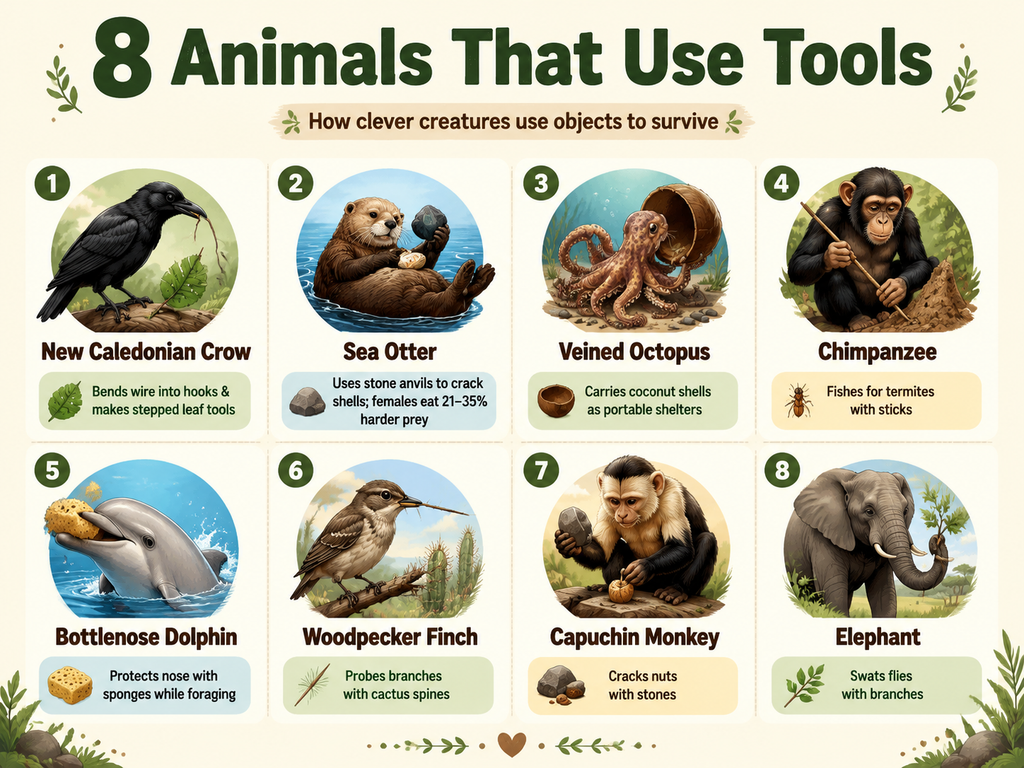
Forget the idea that only humans and primates know how to use tools—animals from the deepest seas to the highest treetops have mastered the art. Here are eight surprising tool users and the clever ways they put their gadgets to work.
Introduction: The Wild World of Animal Tool Use
From crows that bend wires into hooks to otters that crack shellfish on stones, a surprising number of animals use tools to solve problems and get food. Tool use simply means picking up an object from the environment and using it to accomplish a task—and it’s far more common than we once thought. In 2009, researchers stunned the world when they discovered a veined octopus carrying halved coconut shells up to 65 feet across the seafloor and assembling them into a portable shelter—the first documented case of tool use in any invertebrate (National Geographic). This kind of ingenuity appears across the animal kingdom, from birds and mammals to creatures without backbones. In this article, we’ll count down eight of the animal kingdom’s most impressive tool users—master builders, precision problem-solvers, and unexpected innovators. Let’s meet them.
1. Chimpanzees: The Classic Tool Users
Chimpanzees are the poster children of animal tool use, and their termite fishing is the perfect introduction. They carefully select a twig, strip off the leaves, and poke it into a termite mound. When a soldier termite bites down on the intruder, the chimp gently extracts the stick and enjoys a crunchy snack.
But they don't stop at bug forks. Chimpanzees also chew handfuls of leaves into a spongy ball, then dip it into hard-to-reach water and squeeze out a drink. Both tricks are taught from mother to infant—not hardwired instinct—and communities vary their tools. Some groups use heavy stone hammers for nut-cracking; others never touch a rock. It's cultural, passed down in a way that feels remarkably familiar.
2. Orangutans: Ingenious Forest Engineers
Orangutans are nature’s master tinkerers. When a spiky fruit seems impossible to handle, they deftly strip a twig and poke it into crevices to pry out seeds, turning a simple stick into a precision tool. They even fold large leaves into makeshift gloves to grasp prickly stems without getting jabbed. This isn’t random—they purposefully modify materials to solve a specific problem, a hallmark of true forest engineering.
3. New Caledonian Crows: The Feathered Engineers
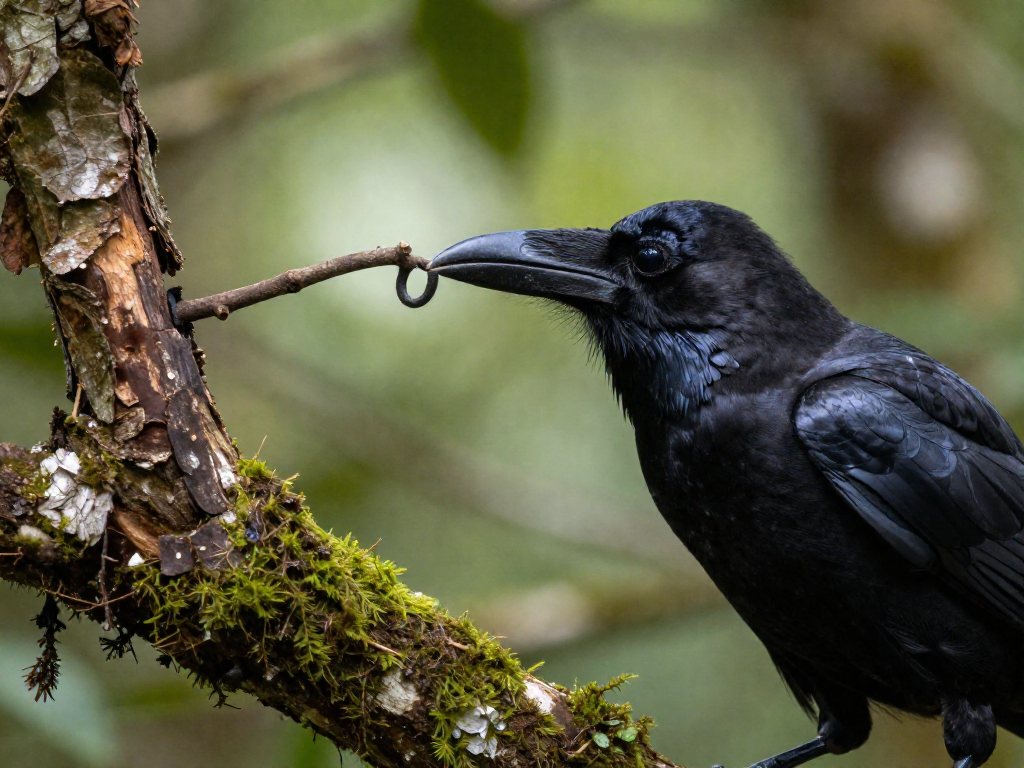
If you think tool use is a primate thing, wait until you meet the New Caledonian crow. On the Pacific island of Grande Terre, these jet-black corvids are nature’s most sophisticated bird engineers, crafting an array of tools that rival anything made by chimps.
Their signature invention is the pandanus-leaf probe. By tearing and snipping into the tough leaf in a precise sequence, a crow produces a tool with a series of “steps”—broad and sturdy at the holding end, tapering to a fine, precise tip. These stepped tools have been found at over 20 sites across the island and even on neighboring Maré, showing just how widespread this cultural behavior is.
Then there’s the legendary Betty. In a 2002 experiment, when her partner made off with the only hooked wire, Betty didn’t give up. She bent a straight piece of wire into a hook with her beak and fished out a tiny bucket of food—a spontaneous feat of mental flexibility that stunned researchers. Later work pushed the boundaries even further. When eight crows were given short sticks that couldn’t reach food, four of them combined pieces to create longer, functional rods. One ambitious crow, Mango, repeatedly built tools from three or even four separate elements. In a study published in Scientific Reports, this wasn’t random tinkering—the crows only combined elements when the food was positioned too far away, showing they planned ahead.
And they’re choosy about their gear. Wild crows show a strong preference for hooked sticks made from the Desmanthus virgatus plant, and once they’ve made a good one, they’ll carefully tuck it underfoot to keep it safe—treating their tools as valuable possessions.
4. Sea Otters: Marine Tool Masters
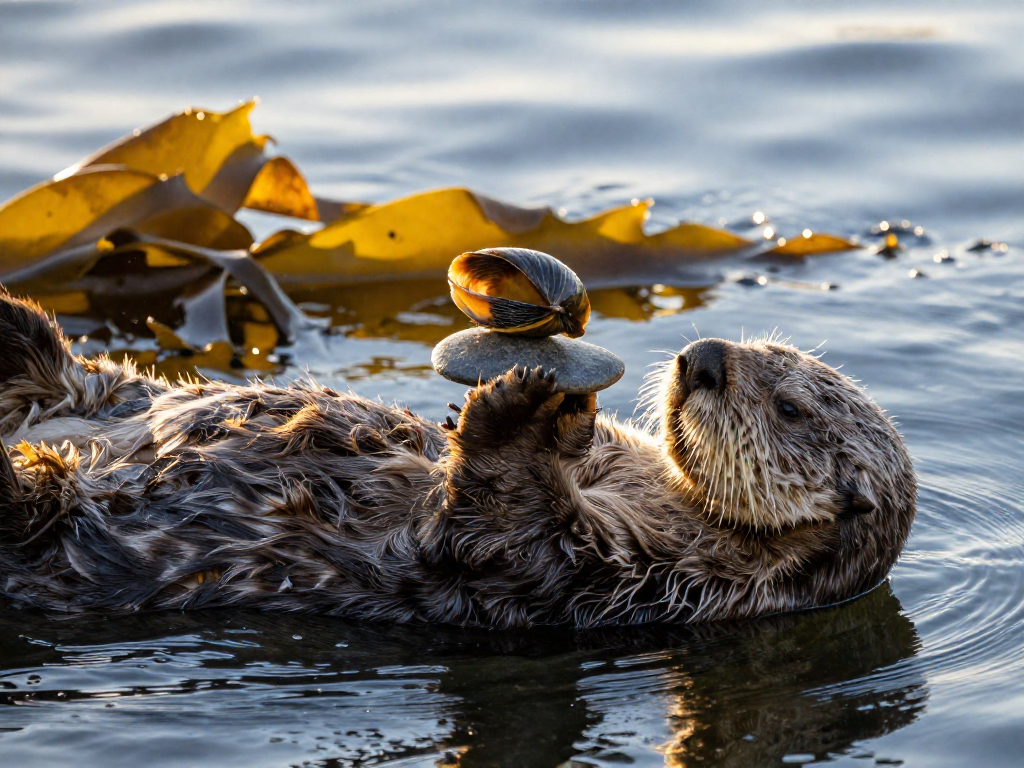
Sea otters don’t just lounge around looking cute—they’re some of the most inventive tool users in the ocean. They employ three distinct methods: balancing a stone on their chest as an anvil to crack open shellfish, wielding a stone as a hammer to dislodge prey from rocks, and wrapping themselves in kelp to create a living anchor so they don’t drift away while eating. With no blubber to keep warm, these marine mammals must consume an astonishing 25–30% of their body weight every single day just to survive. Tools aren’t a fun extra; they’re a necessity that unlocks calorie-dense meals like clams, mussels, and urchins.
A landmark study tracking 196 wild southern sea otters revealed just how much of an edge tool use provides. Tool-using individuals—especially females—could tackle larger, harder-shelled prey, with their meals being 21–35% harder than those of non-users. This mechanical advantage translated directly into better dental health: tool users suffered significantly less tooth damage, because the tools absorb the impact that would otherwise crack teeth. For female otters, who already face higher energetic demands from pup-rearing, intact teeth mean a longer, more successful life. As the research in Science makes clear, this isn’t just a quirky behavior—it’s a survival strategy that directly boosts fitness and lifespan.
5. Veined Octopus: The Coconut-Carrying Cephalopod
Picture an octopus tiptoeing across the seafloor carrying two coconut halves, and you’ve got the veined octopus (Amphioctopus marginatus). In 2009, researchers filmed these octopuses selecting empty shells, scooping out any debris, and then carrying them for up to 20 meters—a long journey for a soft-bodied animal. When they feel exposed, they pull the halves together to form a snug, spherical hiding spot that shields them from predators.
This isn’t just clever; it’s the first documented case of true tool use in any invertebrate (National Geographic). Until then, complex tool behavior was thought to need a backbone and a bigger brain. The octopus shows that sophisticated problem-solving can evolve in a lineage that split from ours over 500 million years ago. It upends the old idea that marine life runs on simple instinct, revealing instead a mind that plans ahead, manipulates objects, and even carries tools for future use—a trait we once thought was uniquely human.
6. Bottlenose Dolphins: Sponging for Supper
In Western Australia’s Shark Bay, a clever group of female bottlenose dolphins has figured out a way to safely hunt on the rocky seafloor: they break off marine sponges and wear them like protective gloves over their snouts. The sponge cushions their sensitive beaks as they probe for hidden fish, preventing scrapes and stings. Even more remarkable, this skill is passed down from mother to calf—a rare example of non-primate culture in the wild.
7. Elephants: The Gentle Giants with Tools
When you’re the biggest animal on land, a simple stick can be a game-changer. Elephants wield branches to swat flies and scratch those hard-to-reach spots, sometimes stripping leaves or snapping them to just the right size. They’ve even been seen dropping logs onto electric fences to disable them—a surprisingly clever problem-solving trick. These gentle giants show that tool use isn’t just for nimble-fingered primates; it’s a common-sense solution for comfort and safety.
8. Woodpecker Finch: Darwin's Little Tool-User
Maybe it’s fitting that one of the most charming tool-using birds lives in the Galápagos, where Darwin first sketched his ideas. The woodpecker finch (Camarhynchus pallidus) lacks the long tongue of a true woodpecker, so it makes do with a cactus spine or a small twig held in its beak to probe for beetle larvae and other insects tucked under bark. Young finches learn this trick by watching adults—an example of tool use that’s passed down culturally rather than coded entirely in genes.
Sources
- New Caledonian crow - Wikipedia — en.wikipedia.org
- Cognitive psychology of tool use in New Caledonian crows (Corvus ... — users.ox.ac.uk
- Compound tool construction by New Caledonian crows | Scientific Reports — nature.com
- New Caledonian crows keep ‘valuable’ hooked tools safer than basic non-hooked tools | eLife — elifesciences.org
- Tool use by sea otters - Wikipedia — en.wikipedia.org
- Tool use increases mechanical foraging success and tooth health in southern sea otters (Enhydra lutris nereis) — science.org
- Shell shock! Octopus spotted using coconuts as shelter in first sign of tool use among invertebrates | Marine life | The Guardian — theguardian.com
- "Bizarre" Octopuses Carry Coconuts as Instant Shelters | National Geographic — nationalgeographic.com
- Meet the Sea Otters: Species, Habitat, and Behaviors - Sea Otter Found — seaotterfoundationtrust.org
See also
- How Smart Are Crows? 10 Facts About Corvid Intelligence
- The World's Most Clever Marine Animals
- Why Octopuses Are the Aliens of the Sea
- Surprising Ways Animals Adapt to Survive
Related articles

My Unpopular Opinion: Stop Calling Them 'Killer' Whales
Why should we stop using the term 'killer whale'?
Jul 28, 2026 · 3 min read
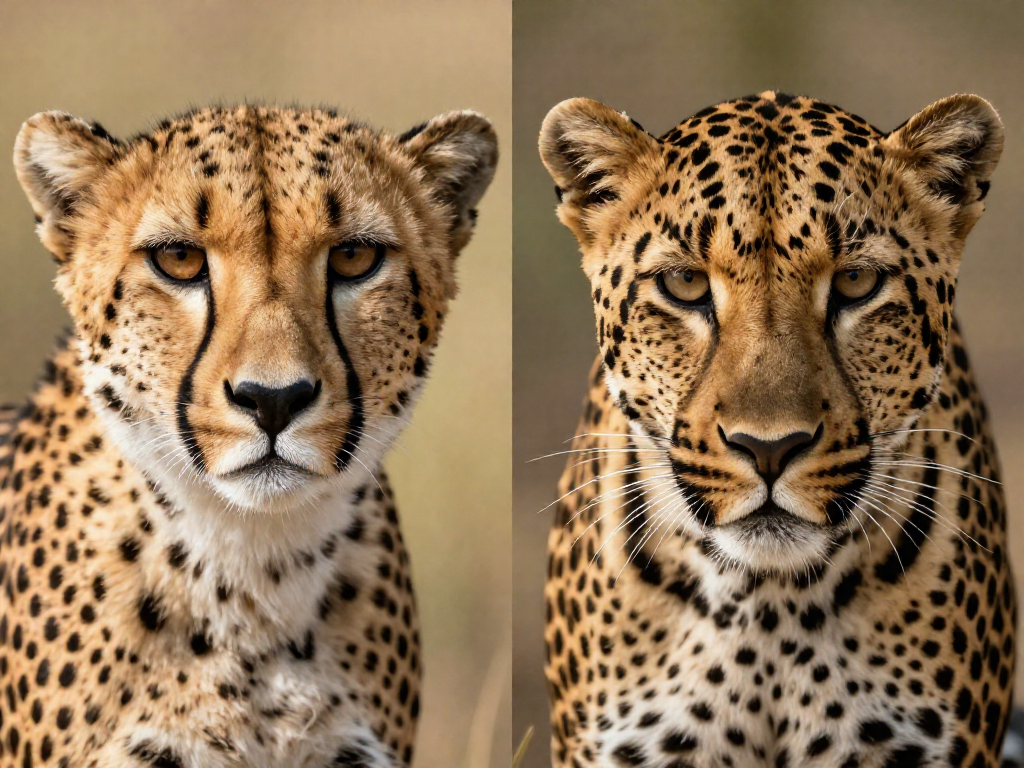
Cheetah vs. Leopard: Spotting the Difference in the Wild
How can you tell the difference between a cheetah and a leopard? Learn the key features including tear marks, spots, body shape, hunting styles, and sounds—all in one easy guide.
Jul 28, 2026 · 6 min read

The Secret Life of the Platypus: Australia's Egg-Laying, Venom-Spurred Oddity
Discover the platypus: an egg-laying mammal with electroreception and venomous spurs. Explore its bizarre evolutionary traits.
Jul 20, 2026 · 7 min read