How Electric Eels Generate Shocks: A Deep Dive into Nature’s Living Batteries
How do electric eels produce electricity?
On this page
With a built-in taser that can reach over 800 volts, the electric eel is one of nature’s most electrifying predators. But how does a creature made of flesh and bone produce such a staggering jolt? This deep dive unravels the hidden cellular machinery and neural choreography that turns an eel into a living battery—from the ion channels inside each electrocyte to the astonishing hunting tactics that remotely control prey.
The Shocking Anatomy: Three Electric Organs in One Body
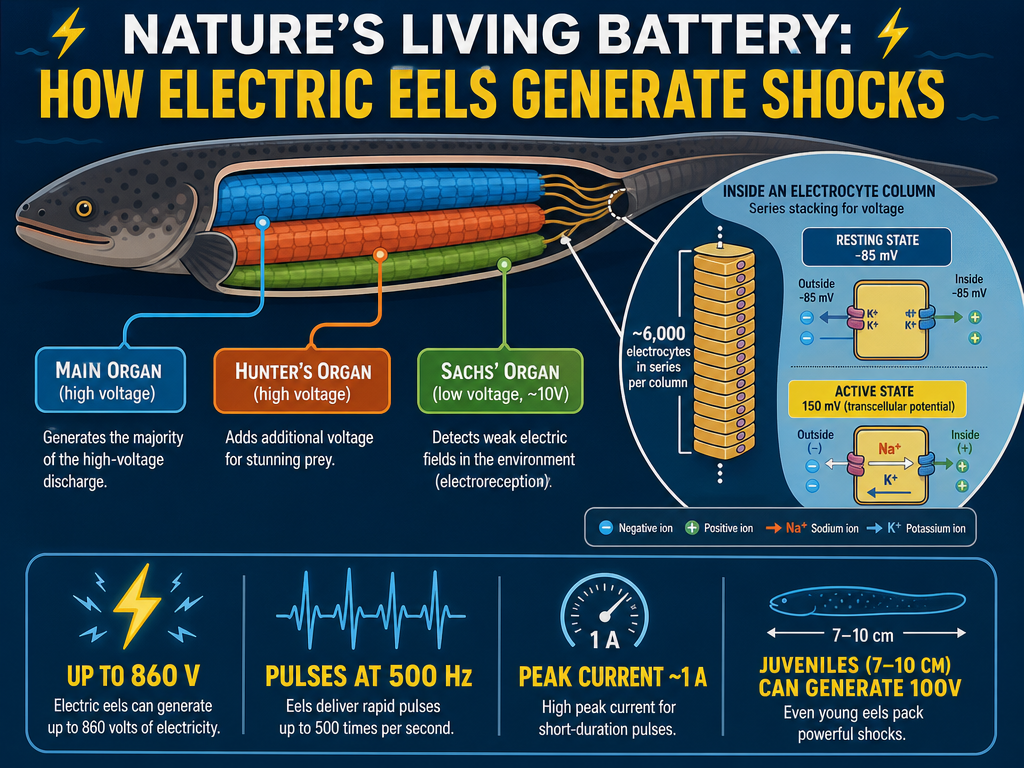
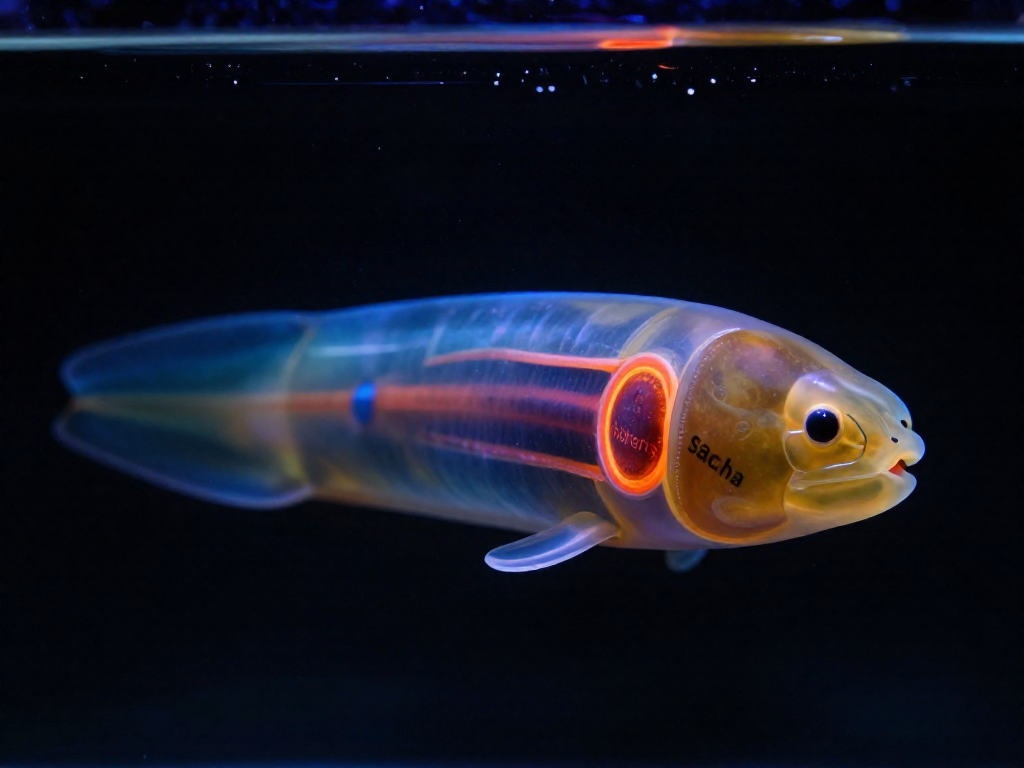
Electric eels don't just have one electric organ—they pack three pairs of them, making up a staggering 80% of their body and turning them into living batteries (Wikipedia). These organs are the main organ, Hunter's organ, and Sachs' organ, each with a distinct job. Together, they can generate everything from subtle, low-voltage pulses for navigation to the high-voltage jolt that stuns prey and deters predators.
The main organ is the powerhouse. Running along much of the eel's body, it stacks about 6,000 specialized cells called electrocytes in series, with around 35 such stacks lined up side by side. This arrangement lets the eel discharge all these cells at once, sending out a shock that can range from 500 volts up to and beyond 600 volts—enough to knock out a fish or give a fisherman a serious tingle. Hunter's organ, located near the head, produces intermediate voltage discharges and likely partners with the main organ during hunting strikes, especially when the eel sandwiches prey between its head and tail to focus the shock.
Then there's Sachs' organ, tucked toward the tail. This one is the whisperer—it fires off gentle, low-voltage pulses around 10 volts. The eel uses these for electrolocation, sensing nearby objects and other eels by reading how the electric field distorts, almost like an underwater radar. The three organs work independently but in sequence, allowing the eel to shift from a quiet scanning mode to a full-blown attack in a split second.
Stacking Voltage: How 6,000 Electrocytes Add Up
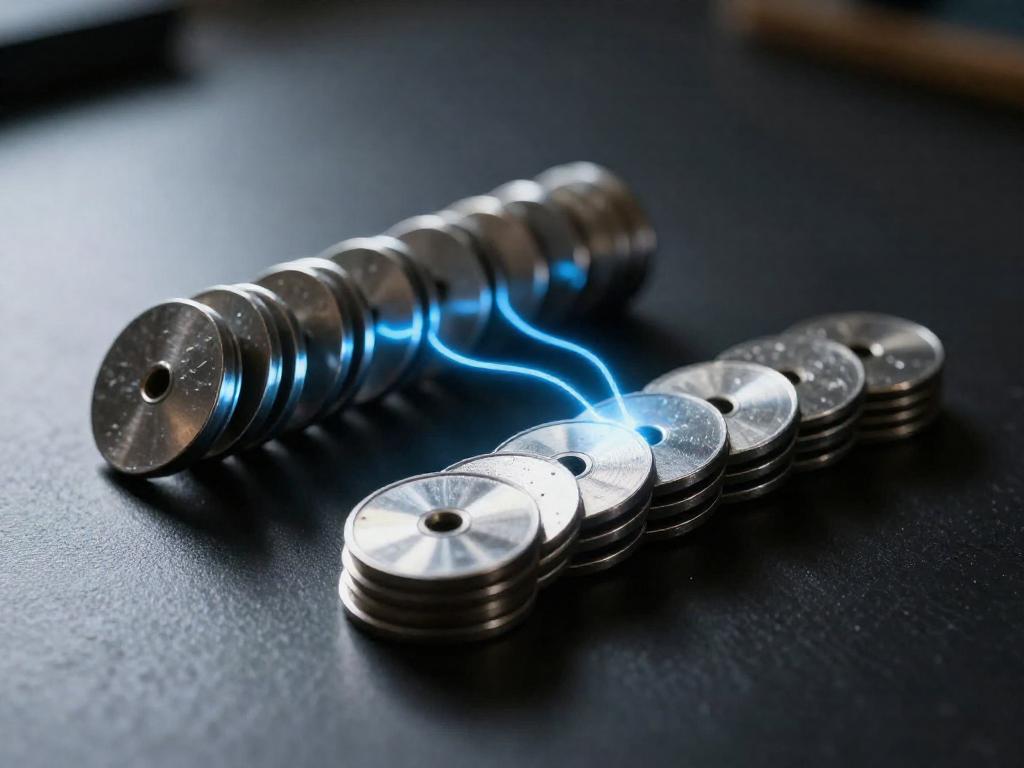
Once the signal fires, geometry takes over. The main electric organ contains roughly 70 columns of electrocytes, each a stack of up to 6,000 disc-shaped cells arranged in series (Wikipedia). That series connection is what pushes the voltage skyward. A single electrocyte nudges ions to create a tiny potential—about 150 millivolts, similar to a typical cell membrane. Lined up end to end, those millivolts add up. In theory, 6,000 × 0.15 V gives 900 volts, though real-world losses and imperfect synchronization trim the largest recorded shock to around 500 V. Still, that’s enough to overwhelm a predator’s nerves.
Voltage alone isn’t the full story. The columns don’t work alone; they’re grouped side by side—roughly 35 stacks on each side of the body, wired in parallel. Where series multiplies voltage, parallel adds current. So while one column can deliver a startling jolt, dozens firing together push amperage to nearly 1 ampere. That combination is what makes the shock so effective. Think of it like stacking AA batteries in a flashlight: arrange them end-to-end (series) and you get a brighter beam; put them side-by-side (parallel) and the same bulb glows longer. The eel does both simultaneously.
Why such high voltage? Because freshwater is a lousy conductor. It has high electrical resistance, so a low-voltage pulse would fizzle out before reaching the target. The eel’s 500-volt spike overcomes that resistance, forcing current through the water and into prey or threats. Marine electric rays face the opposite problem—saltwater conducts almost too well. They generate shocks at just 30 to 50 volts but deliver a much heavier current, perfectly matched to their environment. The eel’s freshwater design is a masterclass in adapting to physics.
Timing sharpens the effect. Electrocytes in the main organ are innervated so they discharge practically at once, producing a high-voltage pulse that lasts only about 2 milliseconds. The eel can fire these in rapid succession—up to 500 times per second—creating a sustained electric assault. This doesn’t just stun; it can exhaust a fish’s neuromuscular system, making escape impossible. Next time you see an electric eel, picture thousands of microscopic batteries, perfectly aligned, firing in a split-second cascade that’s as elegant as it is alarming.
Inside the Electrocyte: The 150-mV Spark Explained
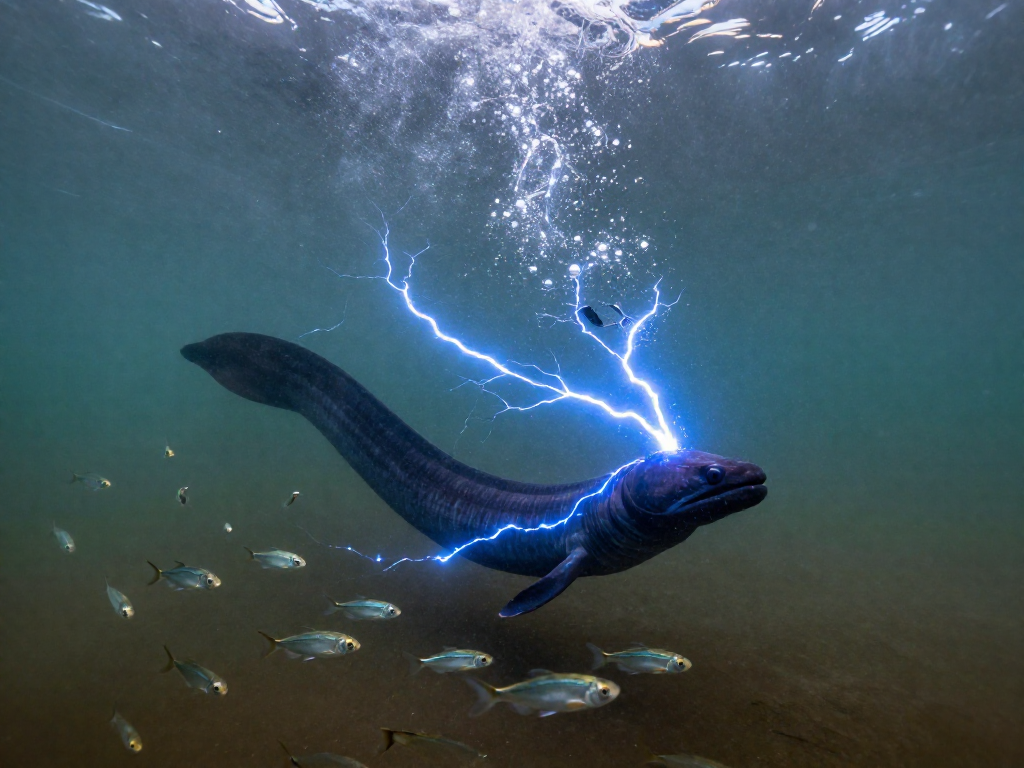
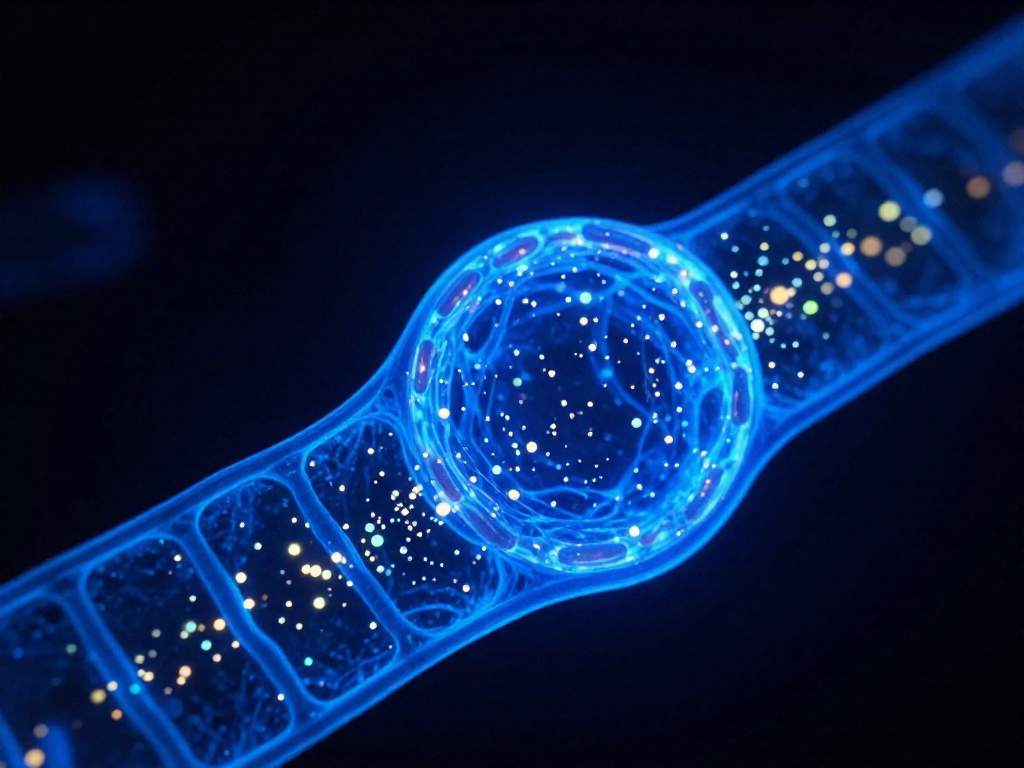
At the heart of the eel's shocking ability lies a microscopic powerhouse: the electrocyte, a flattened, disc-shaped cell that behaves like a miniature biological battery. When the eel is resting, these cells are electrically quiet—their inner voltage sits at a negative -85 millivolts (mV) compared to the outside, maintained by the sodium-potassium pump constantly shuffling positive ions. But they’re primed to flip in an instant.
The secret is in the cell’s two faces. The posterior (back) membrane is studded with voltage-gated sodium channels and directly connected to a nerve ending. The anterior (front) membrane, by contrast, has no such channels; instead, it’s covered in tiny, finger-like projections called papillae that dramatically increase its surface area. This asymmetry is everything.
When the eel decides to shock, its brain fires a rapid signal down a dedicated command neuron. At each electrocyte, nerve endings release the neurotransmitter acetylcholine, which binds to receptors on the posterior membrane. That flips open those sodium channels, allowing positively charged sodium ions to rush in. In about a millisecond, the interior voltage on that side surges from -85 mV all the way to around +65 mV. The anterior membrane, lacking those sodium gates, doesn’t budge—it stays right at -85 mV.
Now you have a tug-of-war across the cell. The difference? +65 mV on the back minus -85 mV on the front gives you roughly 150 millivolts of potential. That’s the raw spark from a single electrocyte—a voltage so tiny it couldn’t power a watch. But multiply it by the 6,000 electrocytes stacked end-to-end in the main organ, and suddenly you’re at hundreds of volts.
Timing is everything. The eel’s nervous system ensures all electrocytes fire simultaneously. Remarkably, each cell is innervated by its own tiny neuron, and those connecting to the farthest electrocytes are thicker and faster to compensate for distance, so the wave of excitation arrives everywhere at once. The result is a crisp, unified discharge that lasts only about 2 milliseconds, yet the eel can repeat it up to 500 times per second—a rapid-fire machine-gun of electricity.
There’s still a puzzle inside these cells. Electrocytes contain five distinct forms of the structural protein desmin. For context, your muscle cells get by with just two or three. The extra desmin varieties probably help the electrocyte withstand the mechanical stress of repeated, violent depolarizations, but as of the latest research, their exact role remains a delightful mystery (Wikipedia).
So, in a nutshell: a single nerve signal causes an asymmetric ionic flood across the electrocyte, creating a quick 150-mV jolt. Stack a few thousand of those jolts together, and you’ve got nature’s most electrifying defense mechanism.
The Neural Orchestra: Timing the Perfect Shock
The entire electrical arsenal is useless without split-second timing. The conductor of this biological symphony is a specialized cluster of neurons deep in the eel’s brainstem—the command nucleus. When it fires, a synchronized volley of signals races down the spinal cord and out through electromotor nerves to thousands of electrocytes, arriving at each cell within a fraction of a millisecond. The result is a single, devastating surge of voltage.
As detailed by MBioS, each electrocyte gets its own dedicated electromotor neuron, and the system has a cunning trick to overcome the anatomical challenge of distance. Electrocytes near the front of each column are physically closer to the brain, but the neurons that control them are smaller in diameter and conduct signals more slowly than the nerves reaching electrocytes at the far end. This size difference neatly cancels out the time lag, ensuring every cell in a column fires at almost exactly the same instant. At the posterior membrane, the nerve endings release a burst of acetylcholine, triggering a rapid inflow of positive ions that flips the voltage from its resting −85 millivolts to about +65 millivolts within a millisecond.
That perfect synchronization lets the eel unleash pulses at breathtaking speeds—up to 500 shocks per second, with each lasting just two milliseconds. Such rapid-fire bursts are the hallmark of a hunting attack. The high-frequency volley overwhelms the prey’s neuromuscular system, causing involuntary muscle spasms that freeze it in place. Once the target is grasped, the eel often curls its body to sandwich the victim between the positive head and negative tail, concentrating the full electric field directly through the prey’s body for maximal effect. Defensive shocks, in contrast, tend to be longer, isolated jolts meant to startle and deter.
Every aspect of this neural orchestration—from the tempo of the command nucleus to the graduated wiring along the electrocyte column—is tuned to produce a weapon that is swift, precise, and remarkably adaptable. In a fraction of a heartbeat, a silent signal can turn an entire bank of living batteries into a coordinated, high-voltage strike.
Hunting with Electricity: Remote Control and Prey Sandwiching
Electric eels don’t just stun prey with a jolt—they use electricity like a remote control, directly manipulating the nervous system of a fish from inches away. The eel’s high-voltage discharge penetrates the water and crosses the prey’s skin, instantly activating motor neurons that command muscles to contract. The result is not a random twitch but a forced, whole-body seizure that leaves the animal immobilized, as thoroughly detailed in The Astonishing Behavior of Electric Eels (PMC). It’s a terrifyingly precise hunting tool honed by evolution.
This remote-control trick works even when the prey is completely hidden. If a fish is buried in murky substrate or tucked behind a rock, the eel can’t see it—but it can make it reveal itself. The eel emits a rapid pair of high-voltage pulses, known as a doublet. These brief shocks cause any nearby animal’s muscles to spasm involuntarily, producing a tiny twitch and a faint water movement. The eel’s body is lined with super-sensitive mechanoreceptors that pick up this disturbance, pinpointing exactly where its next meal is hiding. In this way, the eel can hunt in complete darkness, using electricity as both a weapon and a scout.
Once the eel closes in and grabs a struggling fish, it escalates to an even more brutal method for difficult prey. If the standard wide-field shock isn’t enough, the eel contorts its body to sandwich the prey between its head and tail. Because the head is the positive pole of the discharge and the tail is negative, this positions the victim directly in the strongest part of the electric field. The current is concentrated through the prey’s body, effectively doubling down on the neurological assault. This move, called prey sandwiching, is not a haphazard thrash; it’s a calculated adjustment that ensures a swift kill.
What makes all of this so remarkable is the eel’s delicate control over its own electricity. Each high-voltage shock lasts just about 2 milliseconds, but the eel can fire them at rates up to 500 Hz—a blistering pace that turns individual pulses into a continuous, paralyzing barrage. It can switch from low-voltage probing to high-voltage attacks in an instant, and even modulate the strength and pattern to fit the situation. Far from a dumb battery, the electric eel is a master of electrophysiological warfare, using volts to command prey, detect hidden animals, and deliver a concentrated finish when necessary. It’s a living stun-gun that never misses its mark.
Defensive Leaps and the Softer Side of Shock
Electric eels aren't just underwater hunters — they have a shocking defensive move that seems straight out of a thriller. When threatened, an eel can leap from the water and press its chin against an attacker, delivering a high-voltage jolt directly to the target's nociceptors (pain-sensing nerves). This behavior, documented in a remarkable study, turns a fish into a literal live wire.
But their electrical repertoire has a softer side. The Sachs' organ fires off weak pulses — only about 10 volts — continuously for electrolocation and communication. In the murky Amazon, these gentle zaps help eels navigate and talk to each other. Even juvenile eels, barely longer than a finger at 7–10 cm, can already crank out 100 volts from their developing organs. From delicate probing to full-blown attack, the eel's electric system is as flexible as it is powerful.
Conclusion: The Astonishing Electric Eel
The electric eel is a biological battery like no other. By stacking 6,000 electrocytes and firing them in perfect synchrony, it can unleash up to 500 volts—enough to stun prey or deter a caiman. This dual-purpose electricity powers both a remote-control hunting technique and a shocking defensive leap. The eel’s design is so effective that scientists have already built a soft, water-based battery by stacking hydrogels, mimicking its electrocytes (An Electric Eel-Inspired Soft Power Source).
Sources
- Electric eel - Wikipedia — en.wikipedia.org
- An Electric Eel-Inspired Soft Power Source from Stacked Hydrogels - PMC — pmc.ncbi.nlm.nih.gov
- Monday Article #73: The Electrifying Science of Electric Eels! — mbios.org
- Electric-eels.pdf — uwa.edu.au
- The case for sequencing the genome of the electric eel ... — userweb.ucs.louisiana.edu
- The Astonishing Behavior of Electric Eels — pmc.ncbi.nlm.nih.gov
- How do electric eels work? — nhm.ac.uk
- The third form electric organ discharge of electric eels - PMC — pmc.ncbi.nlm.nih.gov
- Electric Organ Electric Organ Discharge — epub.uni-regensburg.de
See also
- The Shocking World of Electric Animals
- How Venomous Snakes Inject Toxins
- Masters of Disguise: How Octopuses Change Color
- Super Senses: How Bats Use Echolocation
Related articles
How Do Spiders Make Silk? The Chemistry Behind Nature's Strongest Fiber
How do spiders produce silk, and what makes it so strong?
Jul 28, 2026 · 10 min read

Why Don't Woodpeckers Get Headaches? The Built-In Shock Absorbers
How do woodpeckers avoid brain injury despite repeated hammering?
Jul 20, 2026 · 6 min read
How Do Whales Hold Their Breath for So Long? The Superpower of Deep Diving
How do whales hold their breath for extended periods?
Jul 20, 2026 · 6 min read