Why Do Cats Always Land on Their Feet? The Physics of Feline Righting
Why do cats always land on their feet?
On this page
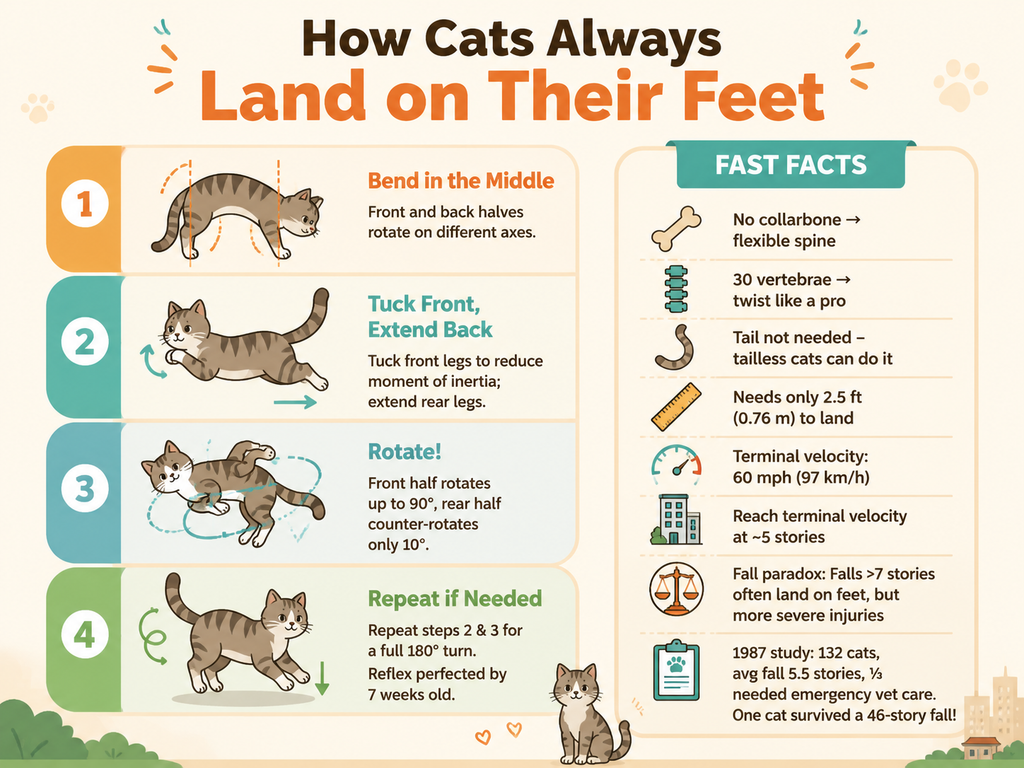
When a cat falls, it seems to defy the laws of physics, spinning in midair with no external push. How does it pull off this vanishing-angular-momentum trick? It’s all in the spine—and a clever re-shaping of its body.
The Cat Righting Reflex: A Step-by-Step Breakdown
Cats land on their feet thanks to an innate superpower called the righting reflex—a lightning-fast, physics-defying twist that flips them upright almost every time. It all starts the moment they lose their footing. Fluid-filled structures in the inner ear, known as the vestibular apparatus, instantly detect that the body is no longer level and send rapid signals to the brain about which way is down. With a total of 30 flexible vertebrae in their spine, cats can then bend in the middle so that the front and back halves rotate around two different axes. Here’s where the real magic happens: the cat tucks its front legs in tight to make the front half spin easily, while stretching its rear legs out to keep the back half from twisting much. This lets the front half rotate up to a full 90 degrees, while the rear half counter-rotates as little as 10 degrees in the opposite direction (Wikipedia). If that’s not enough to complete the 180-degree turn, the cat simply repeats the tuck-and-extend sequence—all in under a second. And this isn’t some slow-motion feat; the whole flip happens so fast that you’d miss it if you blinked. Kittens start trying at around three weeks and master the reflex by seven weeks, proving that a little practice goes a long way. Just remember: a cat needs at least two and a half feet of falling distance to stick the landing.
The Anatomy Behind the Acrobatics
The key to a cat's midair twist lies in an extraordinarily supple spine. With 30 vertebrae—roughly five more than a human—and no functional collarbone, a cat can arch, compress, and rotate its torso way beyond what we can. Where a human spinal twist tops out around 90°, a cat can swivel a full 180° from front to back, letting it whip its body around in a blink.
One common myth is that the tail acts as a counterweight to drive the rotation. Not so: tailless breeds like Manx cats pull off the righting reflex without it. The tail may offer a touch of stability on landing, but the real power comes from that bendy backbone and the ability to rotate the front and rear halves independently (Fear Free Happy Homes).
Learning to Land: When Kittens Master the Trick
Kittens aren’t born with this hidden talent. The righting reflex begins to flicker on at about 3–4 weeks of age and is perfected by 6–9 weeks. Brief zero-gravity experiments in the mid-1900s confirmed the difference sharply: adult cats could still right themselves without any push-off, while very young kittens simply tumbled (Meowant).
The Physics That Makes It Possible (Without Breaking the Laws)
In free fall, gravity pulls every part of the cat with the same acceleration, so there’s no net torque to start it spinning. That means the cat’s angular momentum stays stubbornly at zero from the moment it leaves a surface. So how does it flip over without violating the laws of physics?
The secret is changing shape to exploit differences in moment of inertia—essentially how spread out its mass is. By bending at the middle, tucking the front legs, and extending the rear legs, the front half becomes compact and can rotate as much as 90°. Meanwhile, the rear half stays stretched long, so the same internal twist produces a counter-rotation of only about 10°. If needed, the cat repeats these steps to complete a full 180° turn.
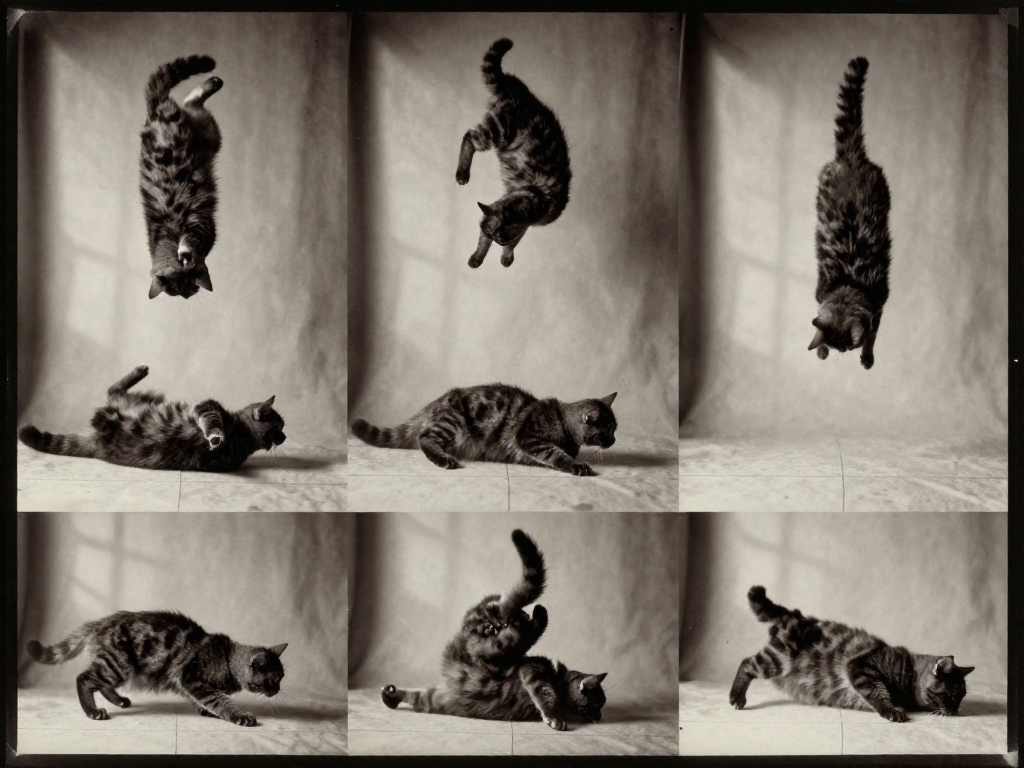
As French scientist Étienne-Jules Marey proved with chronophotography back in 1894, the cat isn’t pushing off a surface and air resistance plays no role (Wikipedia). The puzzle was formally solved in 1969 when researchers modeled the cat as two cylinders connected by a flexible spine—showing that every twist fits neatly within conservation of angular momentum.
Myths: Tail, Air Resistance, and Other Misconceptions
The tail is no propeller—tailless cats do the same twist. Air resistance? 1894 chronophotography showed it plays no role (Wikipedia). And cats can't survive any fall: they need at least 2.5 feet, and high drops are dangerous. A study of 132 cats found a third needed emergency care.
Why Height Matters: The Surprising High-Rise Syndrome
It's natural to assume a longer fall means worse injuries—but with cats, the physics gets strange. The righting reflex needs at least 2.5 feet to even kick in. As height climbs, a cat accelerates until it hits terminal velocity, roughly 60 mph at about five stories.
That’s when things go counterintuitive. A classic 1987 study of 132 cats that fell from high-rises found that those tumbling from over seven stories often had less severe injuries than those falling from two to six stories (Catwatch Newsletter). The hypothesis? At top speed, cats stop struggling and relax, spreading out like a parachute to slow the fall. One cat in the study even survived a 46-story plunge.
But no one should romanticize the ride: one-third of cats in that study would not have survived without emergency medical treatment. A later 2004 study reported a 96.5% survival rate, but with an average fall of just four stories, many cats still landed in the ER. High-rise syndrome is real; just because a cat can beat the odds doesn’t mean it’s safe.
Respect the Reflex, Not a Superpower
The righting reflex is a perfect marriage of physics and biology, spinning a cat upright in under a second. Yet cats aren't invincible—one study found a third of high-rise fall survivors needed emergency care (Rover). Keep windows screened.
Sources
- Cat righting reflex - Wikipedia — en.wikipedia.org
- Why Cats Land on Their Feet: The Righting Reflex – Meowant — meowant.com
- homework and exercises - Is a falling cat's angular momentum conserved? - Physics Stack Exchange — physics.stackexchange.com
- Falling cat problem - Wikipedia — en.wikipedia.org
- Feline Physics: How The Righting Reflex Helps Cats Stick A Landing | Fear Free Happy Homes — fearfreehappyhomes.com
- Learn the Riveting Physics Behind the "Cat-Righting" Reflex - A-Z Animals — a-z-animals.com
- How Cats Land on Their Feet - Catwatch Newsletter — catwatchnewsletter.com
- Righting Reflex: Exploring the Claim That Cats Always Land on Their Feet — rover.com
See also
- How high can cats jump?
- Why do cats purr?
- How do cats always find their way home?
Related articles

Why Do Fireflies Glow? And Other Summer Night Questions
Discover the simple science behind firefly bioluminescence, their coded flash language, and family-friendly tips for enjoying these magical insects without harm.
Jul 20, 2026 · 6 min read
Quick Reference: Common Animal Tracks to Spot in Your Backyard
What animal tracks might you find near your home, and how do you identify them?
Jul 20, 2026 · 4 min read
Why Do Bees Die After They Sting? The Science Behind a Selfless Sacrifice
Discover why only honeybees die after stinging while most bees don’t. The science of barbed stingers, self-amputation, and the surprising banana scent.
Jul 20, 2026 · 4 min read