Why Do Fireflies Glow? And Other Summer Night Questions
Why do fireflies produce light?
On this page
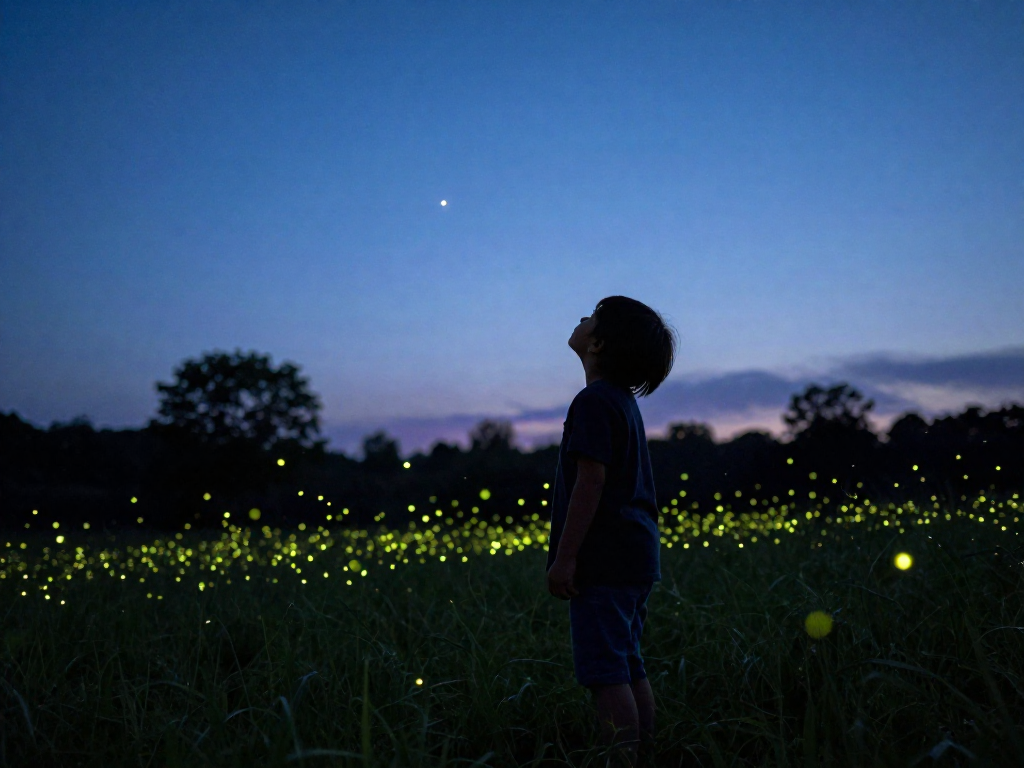
Picture a warm summer evening, the air thick with the scent of grass, when tiny lights start blinking in the dusk. Ever wondered why fireflies glow? This article unravels that mystery and shares how you and your family can become firefly friends this summer.
A Summer Night Mystery
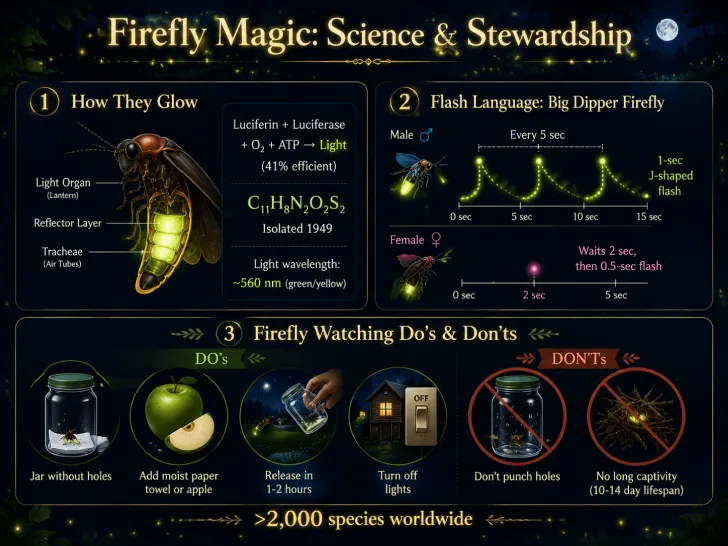
Fireflies produce light by mixing luciferin, the enzyme luciferase, oxygen, and ATP in their abdomens—a glow that’s 41% efficient, outshining any man-made bulb. It’s the magic behind those warm-evening chases. Their flashes are more than random twinkles: they’re coded messages. Male Big Dipper fireflies flash a J pattern every five seconds, and a female replies with a half-second flash after exactly two seconds (NC State News). This article illuminates their blinking language and more summer night secrets.
How Fireflies Turn Chemical Energy into Light
At the heart of every firefly’s glow is a chemical dance so staggeringly efficient it leaves our best light bulbs in the dark. Inside a dedicated light organ located in the insect’s lower abdomen, a reaction converts nearly half of its chemical energy directly into light—an astonishing 41% efficiency, according to research published in PMC. By comparison, a typical incandescent bulb squanders 90% of its energy as heat, while firefly light is almost purely photons; biologists call it “cold light” for good reason, since the abdomen stays cool to the touch even during the brightest flash.
The glow relies on three key players that every firefly carries from birth: the small light-emitting molecule luciferin, the enzyme luciferase that acts as a catalyst, and ATP (adenosine triphosphate), the universal energy currency of living cells. The chemistry unfolds in two neat steps. First, luciferase grips a molecule of luciferin and uses energy from ATP to snap an adenylate group onto it, forming a high-energy intermediate called luciferyl adenylate and kicking out a pyrophosphate molecule. Then the real spectacle begins: oxygen molecules slip into the enzyme’s active site, luciferase catalyzes the oxidation of luciferyl adenylate into oxyluciferin, and as that excited product relaxes back to its ground state, it releases its surplus energy as a photon. The light emerges as a cool yellow-green, centered around 560 nanometers—a wavelength that cuts through twilight especially well.
The whole trick is a timed release of oxygen. The light organ is crisscrossed by fine air tubes that can widen or narrow on demand. When a firefly wants to signal, it opens those pathways briefly; oxygen floods in, the reaction ignites, and the abdomen glows. The instant the oxygen supply is cut off, the light vanishes. That’s how they produce those sharp, purposeful pulses without any nervous flicker. And because the enzyme remains locked and loaded inside the cells, a firefly can flash repeatedly for hours without wearing out or overheating—a tiny living lantern that makes our most advanced LEDs look almost wasteful.
Blink Twice: The Secret Code of Firefly Flash Patterns
Those twinkling lights on a summer evening aren’t random—they’re a high-stakes dating app. The main job of an adult firefly’s flash is to attract a mate, and each species has its own secret code. Think of it as a Morse code that only members of the same kind can understand.
The Big Dipper firefly (Photinus pyralis) offers a perfect example. A male cruises about three feet off the ground, tracing a J-shaped path while he flashes for a full second. He repeats this signal every five seconds. Down in the grass, a female watches. If she likes what she sees, she’ll wait exactly two seconds after his flash, then answer with a quick half-second flicker (NC State News). The timing is so precise it works like a lock and key—if she replies too soon or late, the male might not recognize her.
The variety across species is astonishing. Some fireflies flicker faster than the eye can count—more than 40 times per second—while others produce a slow, luminous glow that lingers for several seconds. These differences prevent embarrassing mix-ups in the dark.
Then there’s the spectacle of synchronous fireflies. In Great Smoky Mountains National Park, Photinus carolinus, and at Congaree National Park, Photuris frontalis, thousands of males flash in eerie unison. The forest transforms into a rhythmic pulse of light, wave after wave.
Not all fireflies keep the party going all night. Some species flash for hours, but others squeeze their entire courtship into a brief 20-minute window at dusk. If you’re lucky enough to catch that window, you know you’re witnessing something ancient, urgent, and utterly precise.
Firefly Deceptions: Stealing Light Signals for a Deadly Meal
That gentle glow isn't just a love note—for many fireflies it's a warning. Their bodies contain lucibufagins, nasty chemicals that make them taste bitter and can cause predators to recoil. How potent? An entomologist once popped a firefly into his mouth and his tongue went numb for an hour, as reported by NC State News. The flash signal likely evolved to advertise this toxicity, a classic “don’t eat me” beacon.
But some fireflies push the deception even further. Females of the genus Photuris are notorious femme fatales. They mimic the specific flash response patterns of Photinus females, luring amorous Photinus males close. Instead of mating, the Photuris female seizes him and devours him. This isn’t just a high-protein snack—she’s after his lucibufagins. By eating him, she steals his chemical defenses and passes them into her own eggs, giving her offspring a toxic shield from the start (RSC Education).
One more glow-detail to tuck away: all firefly larvae (sometimes called glowworms) produce light, but not every adult keeps the talent. Some adult species never flash at all, relying on other survival tricks—though their larval stage still lit up the night.
How to Watch Fireflies Without Harming Them
Watching fireflies is one of summer's simplest pleasures, but a few gentle habits can make a big difference for these short-lived beetles. Adult fireflies live only 10 to 14 days, so every hour matters—keep a captured firefly in a jar for no more than an hour or two before letting it go. And forget the old advice about punching air holes: a jar with no holes and a moist paper towel or apple slice inside will keep the humidity high and the firefly safe (The Allegheny Front).
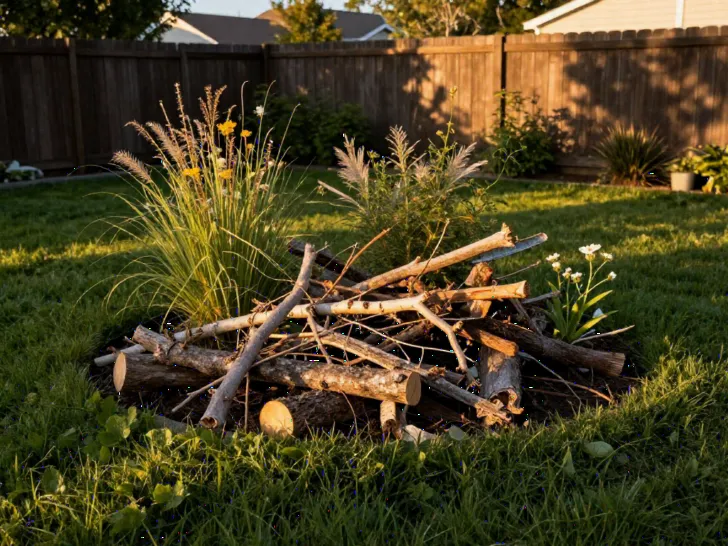
Your yard can become a firefly haven with a few simple tweaks. Turn off outdoor lights during firefly season—bright lights wash out their delicate flash signals, disrupting mating. If you need a flashlight for watching, cover it with red cellophane to minimize disturbance. In a shady corner, a pile of fallen branches makes a perfect firefly hangout, and avoiding pesticides lets larvae thrive in moist soil. Firefly season generally kicks off in late May or June and, as long as conditions stay wet, can stretch into fall.
Quick Answers to Your Burning Firefly Questions
How long do fireflies live? Larvae live 1–2 years; adults only 2–4 weeks.
Why only in summer? They need warm, humid nights for mating, and longer darkness helps their flashes shine.
Do they bite or sting? No, but don’t eat them—their toxins can numb your mouth (as one researcher found out (NC State News)).
How many species? Over 2,000 worldwide.
How can I help? Turn off outdoor lights, leave some tall grass, and skip pesticides.
Sources
- Firefly luciferin - Wikipedia — en.wikipedia.org
- Firefly luciferase - Wikipedia — en.wikipedia.org
- A QM/MM Study on the Initiation Reaction of Firefly Bioluminescence—Enzymatic Oxidation of Luciferin - PMC — pmc.ncbi.nlm.nih.gov
- How do fireflies produce light? | Article | RSC Education — edu.rsc.org
- How Fireflies Glow – and What Signals They’re Sending | NC State News — news.ncsu.edu
- Everything About Luciferin and Luciferase – GoldBio — goldbio.com
- Firefly Mating Signals — ipm.org
- Species-Specific Flash Patterns Track the Nocturnal Behavior of Sympatric Taiwanese Fireflies - PMC — pmc.ncbi.nlm.nih.gov
- Love Fireflies? Here's How to Safely Catch Them - The Allegheny Front — alleghenyfront.org
- How to catch fireflies without hurting them! | Wild Kratts — facebook.com
See also
- The Science of Bioluminescence
- Fun Backyard Science Activities for Kids
- Firefly-Friendly Garden Tips
Related articles
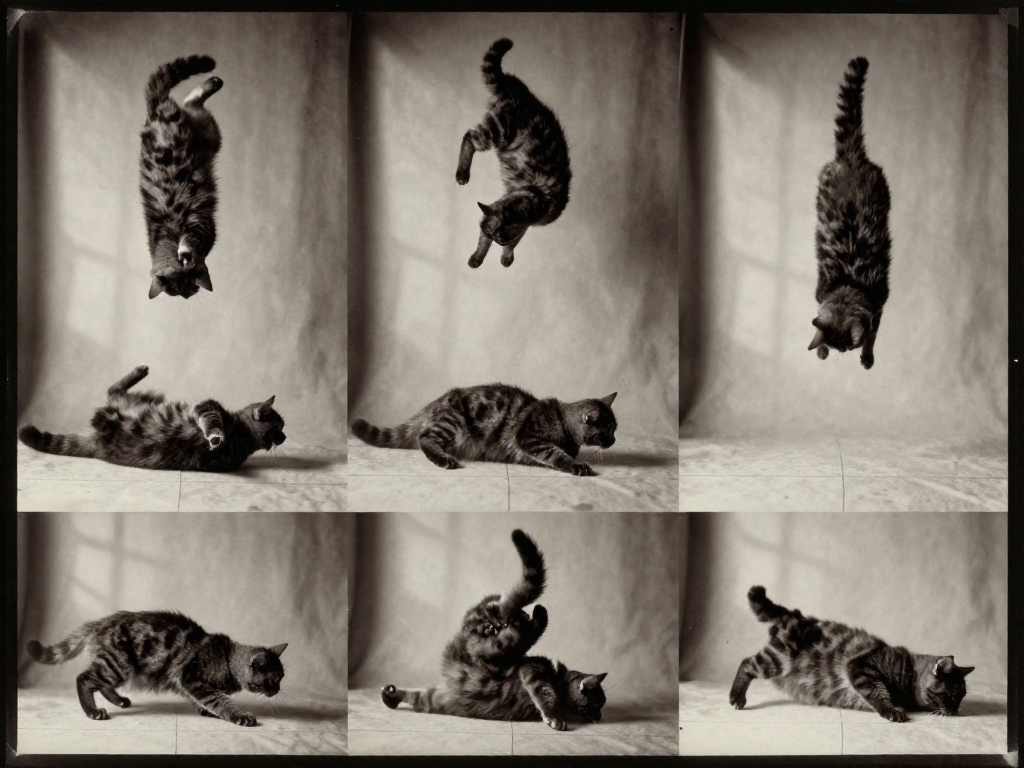
Why Do Cats Always Land on Their Feet? The Physics of Feline Righting
Discover the real reason cats land on their feet—it’s not the tail or magic. Learn the step-by-step righting reflex, the surprising physics behind the twist, and why higher falls can sometimes be safer.
Jul 28, 2026 · 4 min read
Quick Reference: Common Animal Tracks to Spot in Your Backyard
What animal tracks might you find near your home, and how do you identify them?
Jul 20, 2026 · 4 min read
Why Do Bees Die After They Sting? The Science Behind a Selfless Sacrifice
Discover why only honeybees die after stinging while most bees don’t. The science of barbed stingers, self-amputation, and the surprising banana scent.
Jul 20, 2026 · 4 min read