Why Do Some Animals Mate for Life While Others Don't?
Why do certain animals form lifelong pair bonds?
On this page
What "Mating for Life" Actually Means
Here's a fact that surprises almost everyone: the "soulmate" animals you've heard about probably cheat. When biologists say a species "mates for life," they usually mean the partners stay together—not that they stay faithful.
That distinction has a name. Social monogamy means two animals pair up, share a territory, and raise young as a team. Sexual monogamy means they only ever mate with each other. The two are not the same thing, and the gap between them is huge.
In fact, the vast majority of "monogamous" animals are socially monogamous only. DNA testing of nestlings has repeatedly shown that in many famously devoted birds, a surprising share of chicks are fathered by a male who isn't the female's partner. The pair bond is real; the exclusivity often isn't.
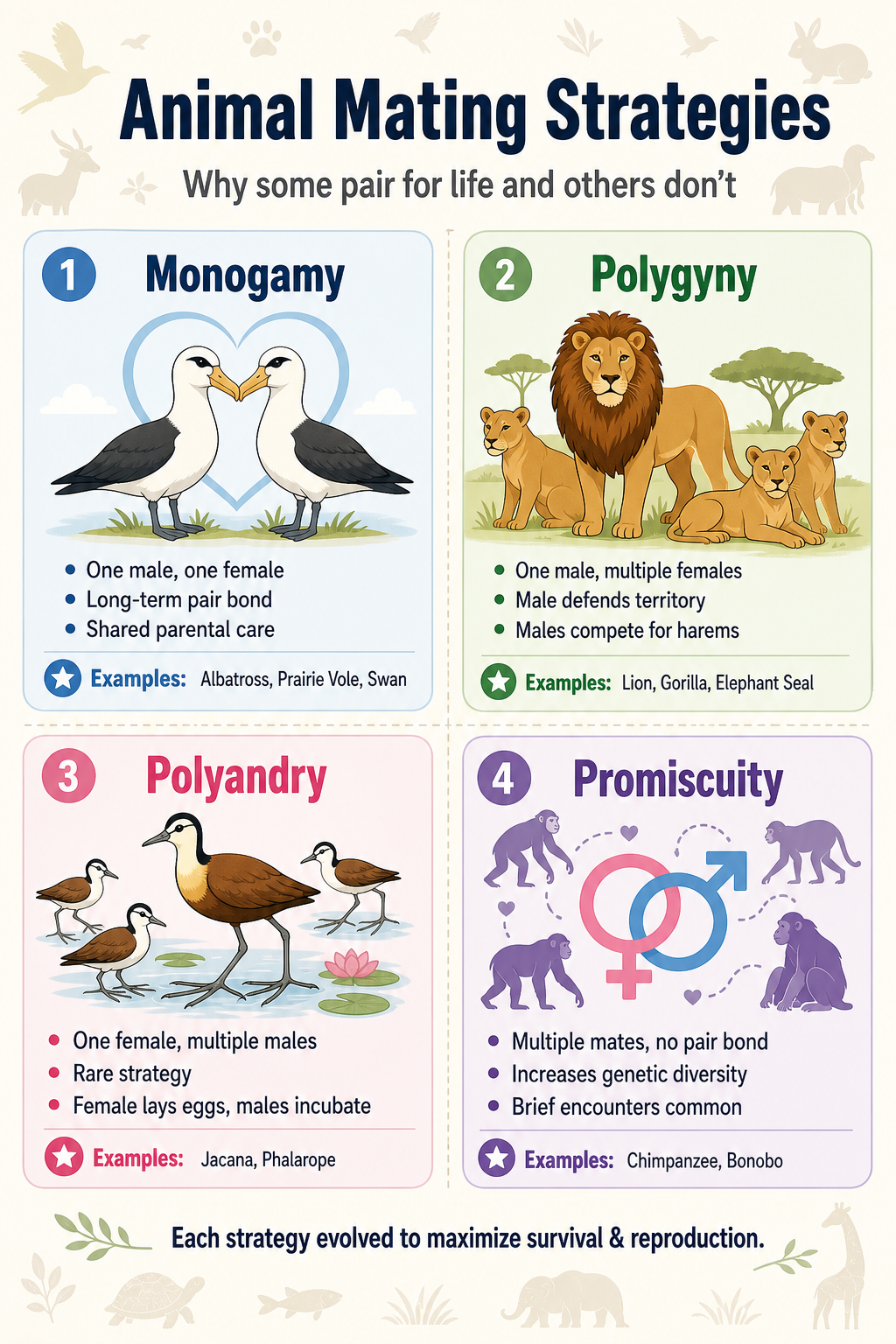
It helps to know the other patterns animals follow:
- Polygyny – one male mates with several females (think elephant seals and their harems).
- Polyandry – one female mates with several males (seen in some shorebirds, where dad does the parenting).
- Promiscuity – both sexes mate with multiple partners and form no lasting bond (common in many mammals).
So where do true lifelong, faithful partnerships fit in? They're the rare exception, not the rule. Across the animal kingdom, genuine "till death do us part" bonds show up in only a small slice of species—which is exactly what makes the animals that do form them so fascinating.
The Real Reason: It All Comes Down to Survival of the Young
Here's the twist: animals don't "fall in love" the way we do. Whether a species pairs up for life or plays the field comes down to one cold, practical question—what gives their babies the best shot at surviving?
Evolution doesn't reward romance. It rewards offspring that live long enough to have offspring of their own. A mating system (the pattern of who pairs with whom) is really just a strategy for solving that math problem. And the answer changes depending on how much help the young actually need.
When two parents beat one. Some babies are so demanding that a single parent simply can't keep up. Many bird species are a perfect example: chicks need constant feeding and warmth, so one parent can incubate while the other hunts. About 90% of bird species form at least seasonal pair bonds, far more than mammals, largely because both parents can share the workload of feeding hungry chicks. When two committed parents roughly double a chick's odds, sticking together pays off.
When one parent is enough. In other species, mom can handle everything alone. A white-tailed deer fawn, for instance, can stand within hours of birth and follow its mother, who needs no help from the father. With nothing useful for him to contribute at the nest, the male's best evolutionary move is to seek out more mates and father more young. No pair bond required.
The hidden variables. Three big pressures tip the scale:
- Energy: How costly is it to raise the young, and can one parent foot the bill?
- Environment: Scarce, scattered food may demand two foragers; abundant food may not.
- Predation: When predators threaten the young, extra eyes and defenders can mean the difference between survival and a wiped-out brood.
So the next time you hear a species "mates for life," remember: it's less about devotion and more about what it takes to get the kids to adulthood.
Animals That Pair for Life (and Why It Works for Them)
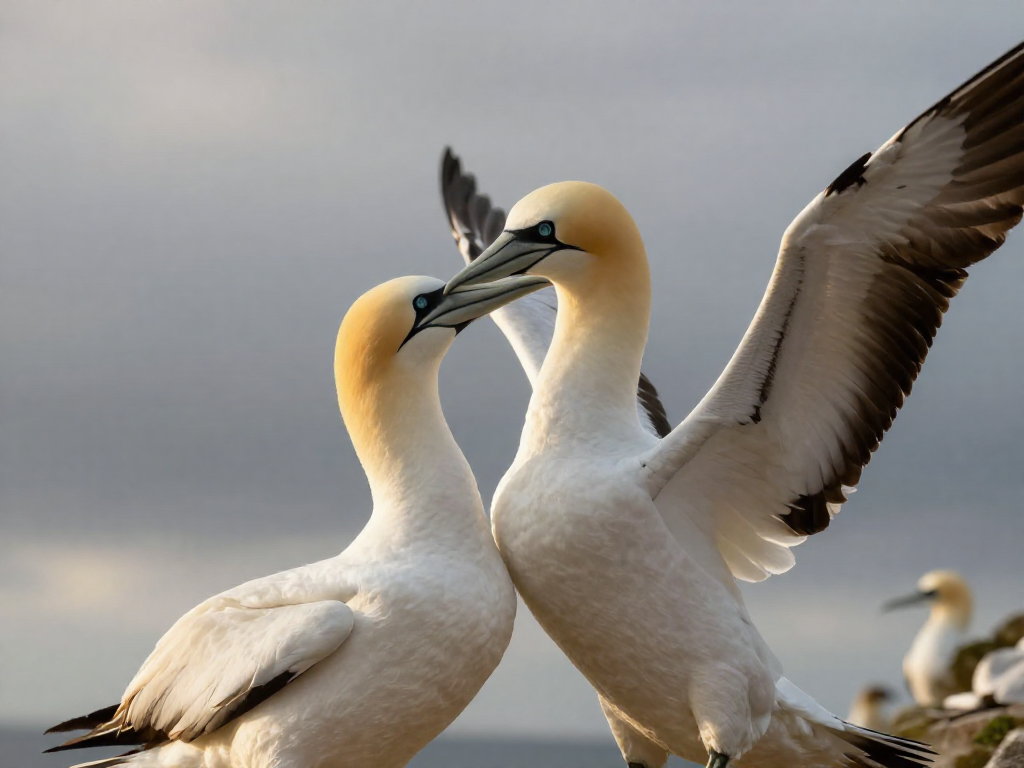
An albatross can spend a decade searching for the right partner—then stay loyal to that bird for 50 years or more. That kind of commitment isn't romance; it's a survival strategy, and it shows up most clearly in animals whose young would never make it alone.
Birds are the undisputed champions of lifelong pairing. Roughly 90% of bird species are socially monogamous (meaning a pair sticks together to raise young, even if they occasionally mate outside the bond). The reason is simple: eggs and chicks are needy. One parent has to keep the eggs warm while the other hunts, and a single bird often can't do both without the nest failing.
A few standout lifelong pairs:
- Albatrosses — court for years, then reunite with the same mate season after season.
- Bald eagles — return to the same partner and nest, adding to it until it can weigh over a ton.
- Prairie voles — small rodents that form some of the tightest bonds in the animal world.
- Gibbons — tree-dwelling apes that live in close family pairs.
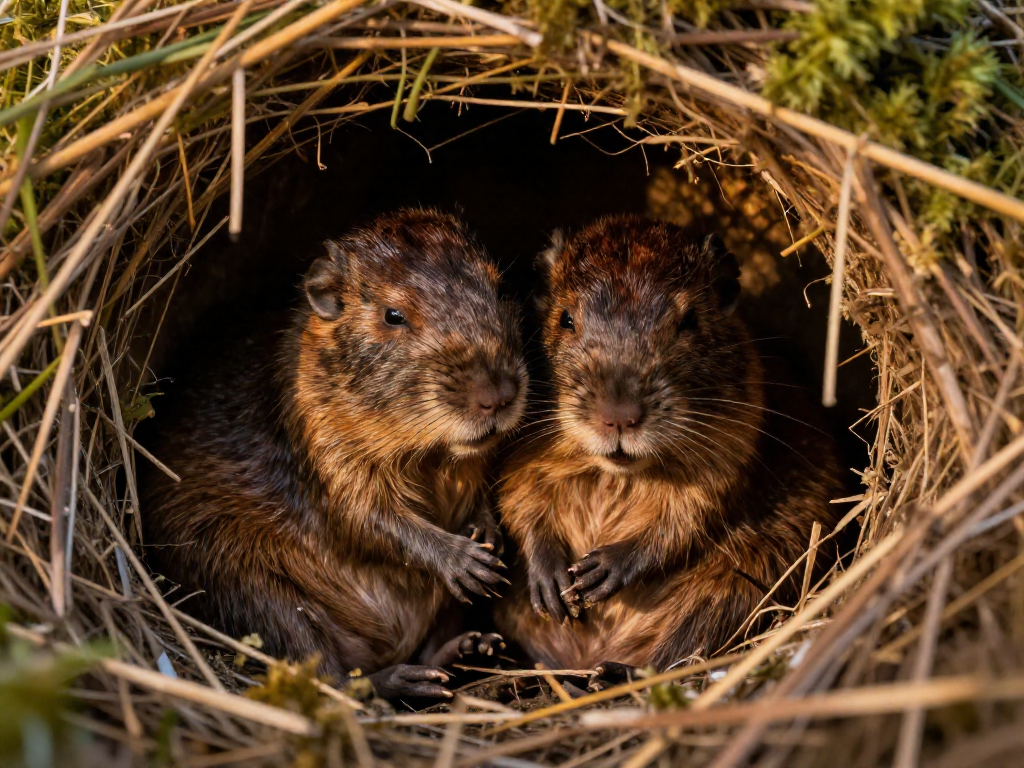
- Beavers — partners who build and defend a lodge together for life.
Notice a pattern: many of these animals live where conditions are harsh, food is scattered, or raising offspring is a heavy job. When survival demands constant effort, two committed parents simply outperform one—more food gathered, more protection, better odds the babies live.
The prairie vole reveals what's happening under the hood. After mating, these voles release two hormones—oxytocin (often called the "bonding hormone") and vasopressin—that wire them to prefer and stay near their partner. Scientists have even shown that adjusting these chemicals changes how strongly voles bond, which is why this unassuming rodent has become a star of relationship research.
In short, lifelong pairing isn't about love as we know it. It's nature's answer to a hard question: how do you keep the next generation alive?
Animals That Don't—and the Logic Behind Their Strategies
Here's the twist: out of roughly 5,000 mammal species, only about 3–5% form lasting pair bonds. For most of the animal kingdom, not settling down is the winning strategy—and there's cold, clever math behind it.
Polygyny: one male, many females
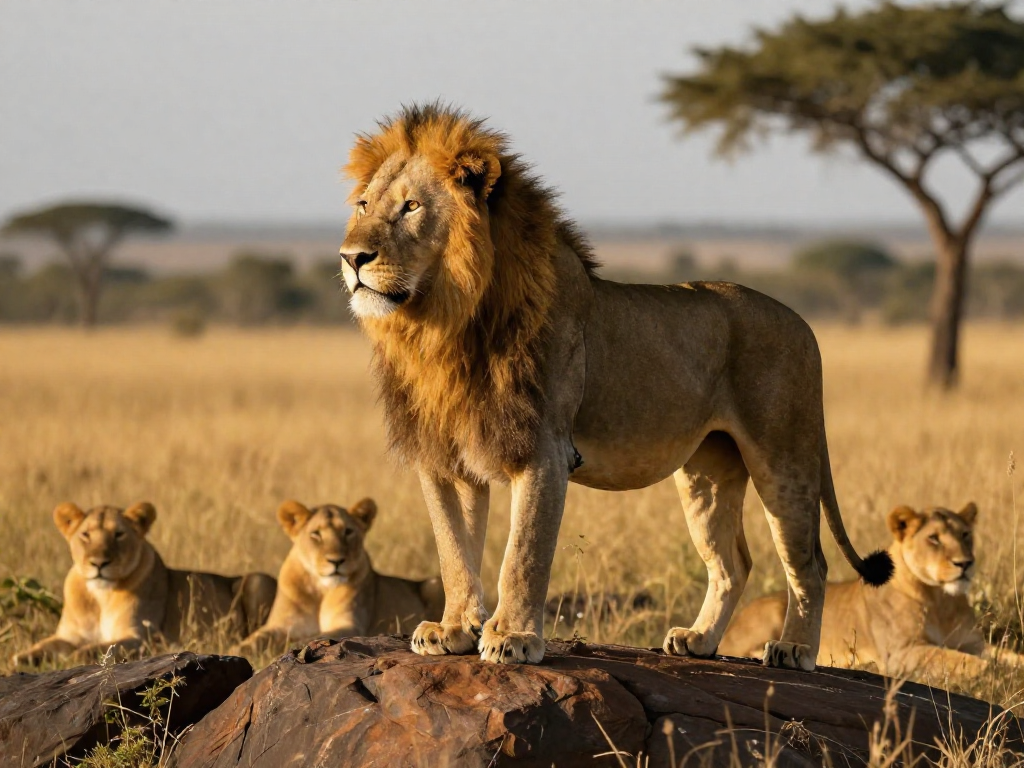
This is the classic "harem" setup you see in lions, elephant seals, and red deer. One dominant male guards access to many females, usually by controlling territory, resources, or sheer muscle. A single elephant seal bull can mate with dozens of females in a season, while most rival males get nothing. The payoff is brutal but simple: if you can out-fight or out-resource your rivals, you father a huge share of the next generation. The catch? Only a few males ever win, which is why males of these species are often much bigger than females.
Polyandry: one female, many males
Flip the script and you get polyandry, where one female mates with several males—and the males do the parenting. Female jacanas (tropical wading birds) defend a territory, lay clutches of eggs for multiple male partners, and leave each dad to incubate and raise the chicks. Some fish work the same way. When males handle childcare, a female's best bet is to produce as many eggs as possible across as many mates as she can.
Why mammals mostly skip monogamy
The big reason comes down to who feeds the babies. In mammals, mothers produce milk, so a female can raise young entirely on her own—no dad required. That frees males to seek more mates. Birds are the opposite: chicks often need two parents to keep eggs warm and bring food, so about 90% of bird species are at least seasonally monogamous. Different chores, different love lives.
The Messy Truth: Cheating, Divorce, and Re-Pairing
Here's the plot twist: many animals we call "mates for life" are quietly raising chicks that aren't related to their partner. When scientists started running DNA paternity tests on songbirds in the 1980s and '90s, the results were jaw-dropping—in some socially monogamous species, a third or more of the chicks in a nest were fathered by a neighbor. Biologists call this extra-pair copulation (mating outside the main pair bond), and it turns out to be remarkably common even among devoted-looking couples.
So pairs can stay together while still playing the field. Why? Sticking with one partner helps share the heavy lifting of raising young, but sneaking in extra genes can give offspring a better shot at survival.
The surprises don't stop there:
- Birds get "divorced." After a failed breeding season, some pairs split and find new partners. In one long-term study of black-legged kittiwakes (a type of gull), pairs that failed to raise chicks were far more likely to break up than successful ones.
- Re-pairing is normal. When a mate dies, most "lifelong" species don't grieve forever—they find a new partner and carry on.
The takeaway? Monogamy in the animal world is a spectrum, not a fairy tale. "Mating for life" usually describes a working partnership, not a vow of perfect fidelity—and that's exactly what makes it so fascinating.
Quick Takeaways: Mating Systems at a Glance
Here's the surprising bottom line: lifelong love stories in the animal kingdom are rare, and they're not about romance at all—they're about getting babies to survive. Here's the cheat sheet:
- Monogamy (one lifelong partner): Two parents share the workload, so demanding chicks or pups are more likely to survive. Think albatrosses and gray wolves.
- Polygyny (one male, several females): One strong male defends a territory or harem; females raise young solo. Common when food is plentiful and dads aren't essential—like elephant seals.
- Polyandry (one female, several males): Rarer flip of the script, where males do the parenting. See it in some shorebirds, like jacanas.
- Promiscuity (many partners, no bonds): Maximizes genetic mixing when parental care isn't needed at all.
The memorable stat: About 90% of bird species form pair bonds, versus only 3–5% of mammals.
The takeaway? It's strategy, not sentiment—whatever helps the next generation make it.
See also
- How Do Animals Choose Their Mates?
- Why Do Birds Sing in the Morning?
- Surprising Animal Parents That Do It All Themselves
- Animals With the Strangest Courtship Rituals
Related articles

When Your Dog Won't Stop Licking: A Troubleshooting Guide for Common Causes
Why does my dog keep licking everything, and how can I address it?
Jul 28, 2026 · 7 min read
Why Do Birds Sing at Dawn? The Science of the Dawn Chorus
Why do birds sing so loudly early in the morning?
Jul 28, 2026 · 6 min read
Monogamy vs. Polygamy in the Animal Kingdom: A Comparative Guide
How do monogamous and polygamous mating systems compare, and which animals use which?
Jul 20, 2026 · 9 min read