Octopus vs. Squid: How to Tell Them Apart
What's the difference between an octopus and a squid?
On this page
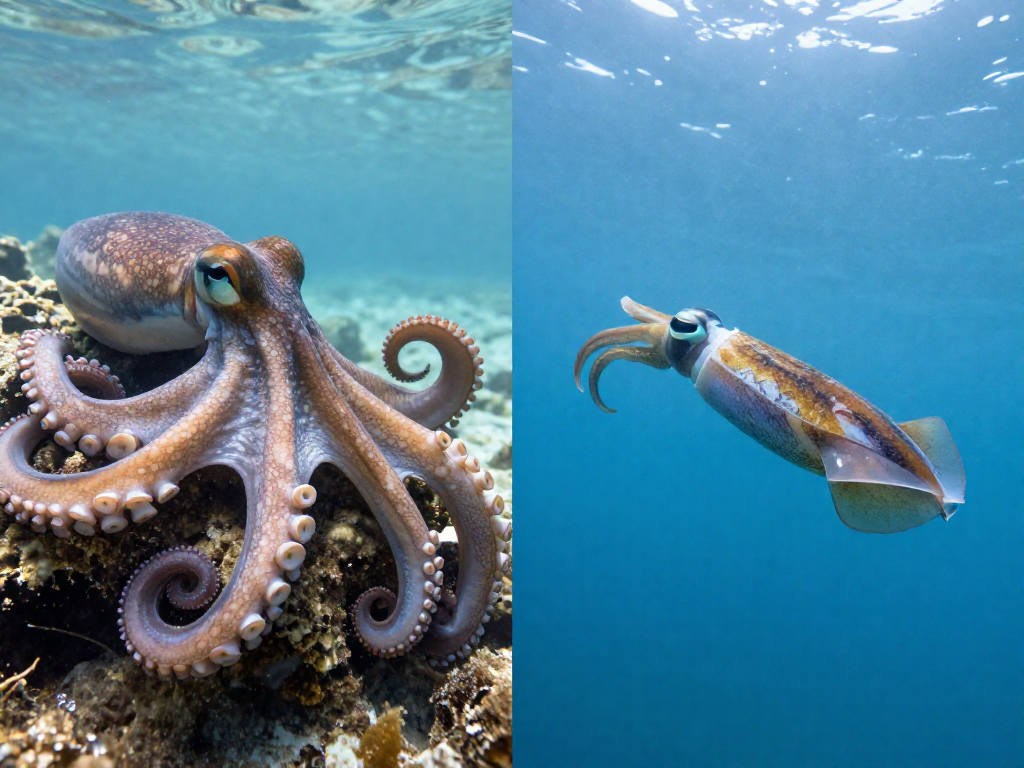
The Quick Answer: Octopus vs. Squid at a Glance
Here's the fastest way to tell them apart: an octopus has 8 arms and a round, soft, baggy body, while a squid has 8 arms plus 2 long tentacles and a streamlined, torpedo-shaped body with fins. That's the whole difference in one breath.
Both belong to a group called cephalopods (a family of soft-bodied, brainy ocean animals that also includes cuttlefish and the shelled nautilus). But despite the family resemblance, they live very different lives: octopuses tend to be solo, den-dwelling crawlers of the seafloor, while squids are fast, open-water swimmers that often travel in groups.
Want the cheat sheet? Pin the quick-reference table below — it lines up every key trait side by side so you can settle the "is that an octopus or a squid?" debate in seconds.
| Feature | Octopus | Squid |
|---|---|---|
| Limbs | 8 arms | 8 arms + 2 tentacles |
| Body shape | Round, soft | Torpedo-shaped, with fins |
| Lifestyle | Seafloor crawler | Open-water swimmer |
Arms vs. Tentacles: Counting Limbs (The #1 Tell)
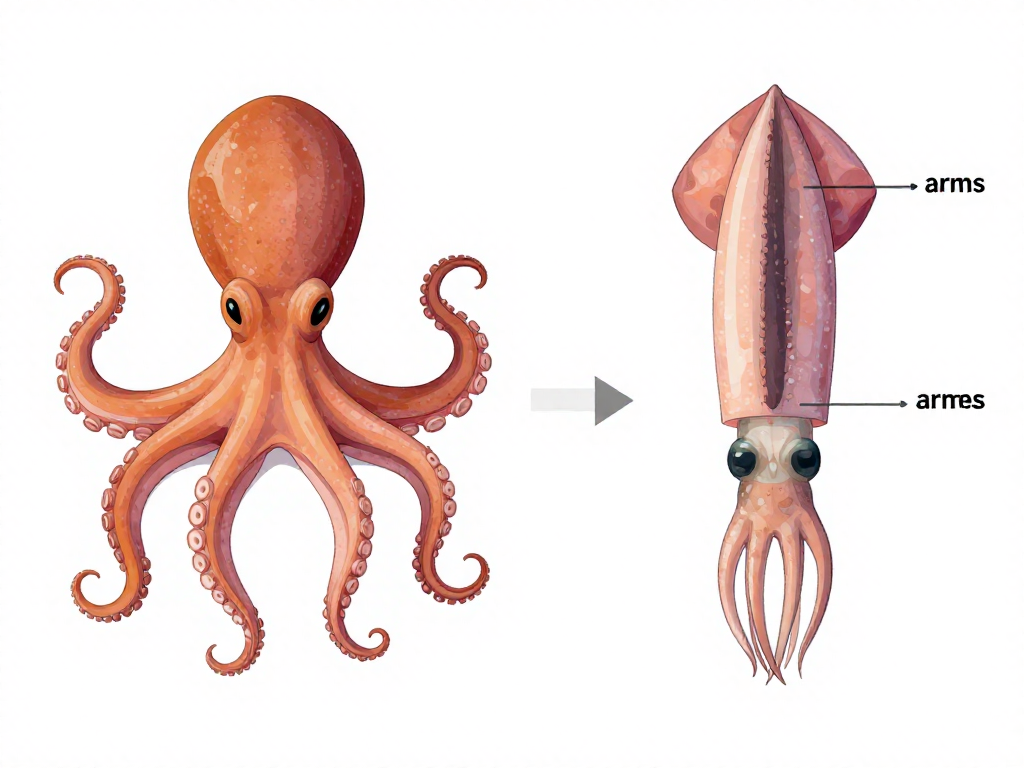
Here's the fastest way to win any octopus-or-squid argument: count the limbs. An octopus has exactly 8 arms and nothing else. A squid has 10 limbs total—8 arms plus 2 extra-long feeding tentacles. Spot those two long stretchy ones, and you're looking at a squid.
The difference isn't just the number—it's the job each limb does.
- Octopus: 8 identical arms, each lined with suckers from base to tip. They're all-purpose tools for crawling, grabbing, tasting, and even opening jars.
- Squid: 8 arms for holding and handling food, plus 2 longer tentacles that stay tucked away until mealtime. Those tentacles have suckers mostly at the flattened tips, called "clubs."
- How they hunt: A squid's tentacles shoot out in a split-second strike to snag fast prey like fish and shrimp, then pull it back so the 8 arms can grip and maneuver it toward the beak.
Now the myth-buster: people call any dangly sea limb a "tentacle," but that's not quite right. Technically, an arm has suckers along its whole length, while a tentacle is a longer limb with suckers clustered at the end. So an octopus has zero tentacles—just eight very talented arms.
Quick check next time: 8 limbs = octopus, 10 limbs = squid.
Body Shape: Round Bag vs. Torpedo
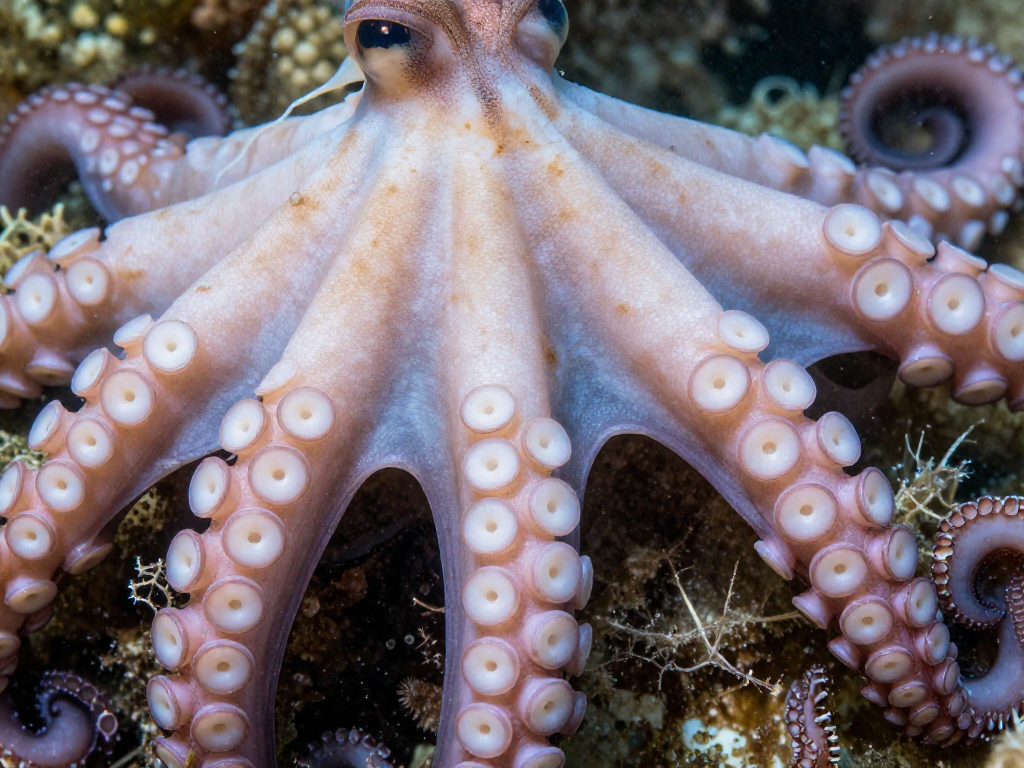
Squint at a blurry photo and you can still tell these two apart in a heartbeat: an octopus looks like a soft, round bag, while a squid looks like a torpedo with fins. That single silhouette is the fastest ID trick there is.
An octopus has a bulbous, baglike mantle (the main body sac behind the head) that's soft and boneless from end to end. With no internal skeleton at all, an octopus can pour its entire body through a gap the size of its eye — which is why they're famous escape artists and crevice-dwellers.
A squid is built for speed instead. Its mantle is long, tapered, and streamlined, tipped with a pair of triangular fins it uses to cruise open water. Inside runs a stiff, feather-shaped support called a gladius (or "pen") — the closest thing a squid has to a backbone, made of a flexible, plasticlike material.
Shape follows lifestyle here:
- Octopus: soft, finless, and squishy — a seafloor ambush hunter that hides and squeezes into tight spots.
- Squid: sleek, finned, and rigid-cored — an open-ocean swimmer built to chase prey and flee predators.
So in any side-by-side: round bag = octopus, pointy torpedo = squid.
Where They Live and How They Move
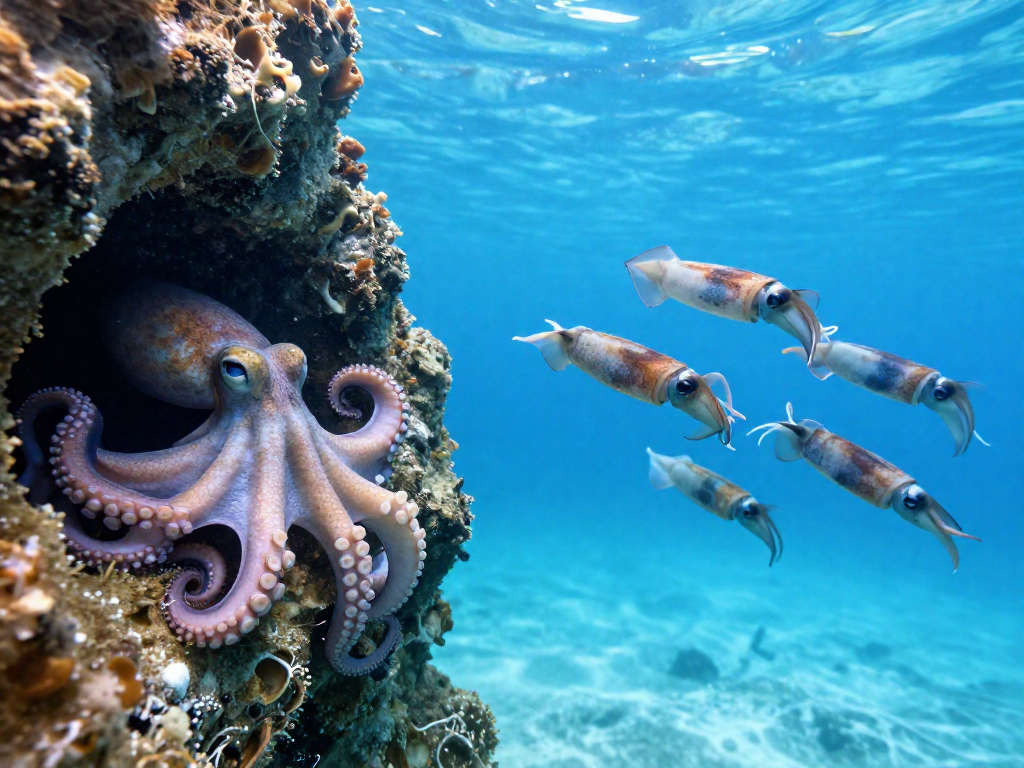
Here's a quick way to picture the difference: an octopus is a homebody, while a squid is a long-distance commuter. That single contrast explains a lot about how each one is built.
Octopuses are mostly bottom-dwellers. They prowl the seafloor and tuck themselves into rocky crevices, coral reefs, and even discarded shells or bottles, squeezing their boneless bodies into surprisingly tiny dens. Most of their day is about hiding, hunting nearby, and slipping back to safety.
Squids, by contrast, are built for open water. Many species cruise the open ocean in schools, gliding and darting with jet propulsion (squirting water through a funnel-like siphon to push themselves along). Their torpedo shape and fins make that swimming smooth and efficient.
Both groups use jet propulsion, but squids depend on it for sustained, fast travel, while octopuses mostly save it for quick escapes.
One caution so you don't get over-confident: their worlds do overlap. Some octopuses swim well above the bottom, and certain squid species live near the seafloor or in deep water. Habitat is a strong clue, not a guarantee.
Brains and Behavior: Master Escape Artist vs. Speedy Hunter
An octopus once unscrewed a jar lid from the inside to escape, and another famously slipped out of its aquarium, crossed the floor, and squeezed down a drainpipe back to the sea. That's the headline difference here: octopuses are the brainy escape artists, while squids are the fast, coordinated hunters of the open ocean.
Octopuses are some of the smartest invertebrates (animals without a backbone) on Earth. They solve puzzles, use coconut shells and rocks as tools and shelter, open jars for a snack, and pry their way out of tanks. With around 500 million neurons—two-thirds of them spread through their arms—each arm can practically "think" for itself.
Squids are clever too, but in a different way. Many species are built for speed and live in groups, coordinating to hunt and travel. Some even flash patterns across their skin to signal one another.
Both are camouflage champions, thanks to chromatophores (tiny color-changing cells in the skin) that let them shift shade in an instant to hide or communicate.
Here's the truly mind-bending part: octopuses (and squids) can edit their own RNA—the molecule that carries DNA's instructions—to fine-tune how their nerves work, possibly helping them adjust to cold water. It's a rare trick almost no other animals pull off.
Lifespan, Size, and Other Surprising Differences
Here's a fact that surprises almost everyone: most octopuses and squids live only 1 to 2 years, and many die shortly after reproducing. These clever, complex animals pack their whole lives into a span shorter than a goldfish's.
Their sizes, though, span an astonishing range. Some species are barely bigger than your thumb, while the giant Pacific octopus can stretch its arms over 14 feet across. Squids go even bigger: the colossal squid and giant squid are among the largest invertebrates (animals without backbones) on Earth, with giant squid reaching an estimated 40+ feet long.
Their menus differ, too:
- Octopuses are bottom-dwelling hunters that favor crabs, clams, and other shellfish, often prying or drilling into shells.
- Squids are open-water chasers that pursue fish and shrimp, snatching prey with their two long feeding tentacles.
Both can also blast a cloud of ink to escape predators. An octopus typically uses ink as a "smoke screen" to vanish along the seafloor, while a fast-swimming squid may release an ink blob and jet away, leaving a confusing decoy behind.
The Cheat Sheet: Telling Them Apart in 5 Seconds
Spotted a mystery sea creature and don't have time for a deep dive? Run through this quick checklist and you'll have your answer before the next wave.
- Count the limbs. Eight arms = octopus. Ten (eight arms plus two longer feeding tentacles) = squid.
- Check the body. A round, soft, baggy head means octopus. A sleek, torpedo-shaped body with fins on the sides means squid.
- Note the location. Crawling or hiding on the seafloor? Probably an octopus. Jetting through open water? Likely a squid.
One more look-alike: the cuttlefish. It also has ten limbs like a squid, but it's shorter and wider with a flatter, oval body and a broad fin running around its edges—so if it doesn't quite fit either box, you may have found a third cephalopod (the group that includes octopuses, squids, and cuttlefish).
Memorize those three checks and you'll never mix them up again.
See also
- How Octopuses Change Color: The Science of Cephalopod Camouflage
- Are Octopuses Really That Smart? Surprising Signs of Intelligence
- Giant Squid vs. Colossal Squid: What's the Difference?
- What Is a Cephalopod? Meet the Ocean's Brainiest Invertebrates
- Why Do Octopuses Have Three Hearts and Blue Blood?
Related articles

My Unpopular Opinion: Stop Calling Them 'Killer' Whales
Why should we stop using the term 'killer whale'?
Jul 28, 2026 · 3 min read
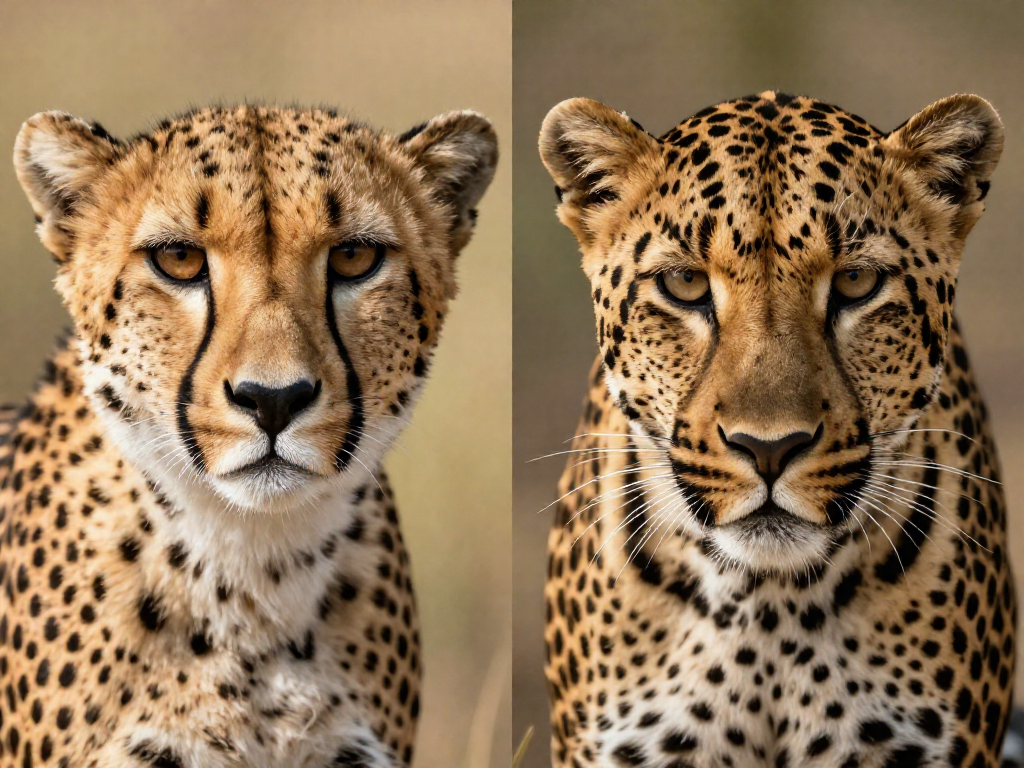
Cheetah vs. Leopard: Spotting the Difference in the Wild
How can you tell the difference between a cheetah and a leopard? Learn the key features including tear marks, spots, body shape, hunting styles, and sounds—all in one easy guide.
Jul 28, 2026 · 6 min read
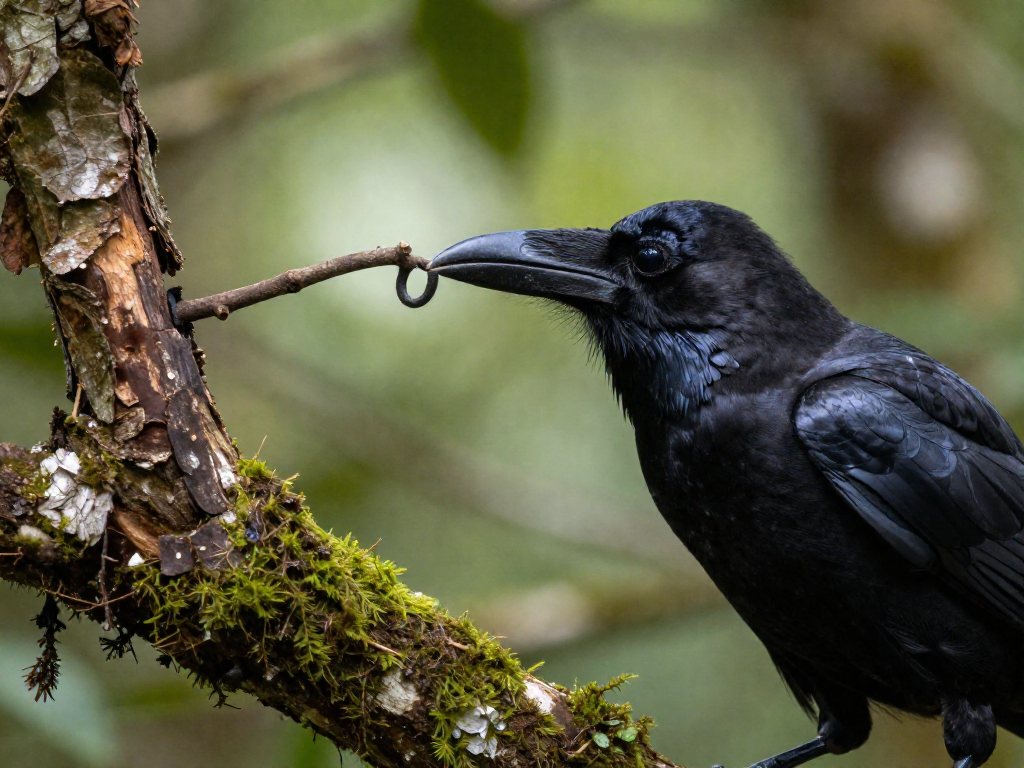
8 Animals That Use Tools (And What They Do with Them)
Which animals use tools, and how do they use them? From crows bending wires to octopuses carrying coconuts, discover 8 tool-using animals.
Jul 28, 2026 · 6 min read