Master of Disguise: How Animal Camouflage Actually Works
How do animals camouflage themselves and what kinds exist?
On this page
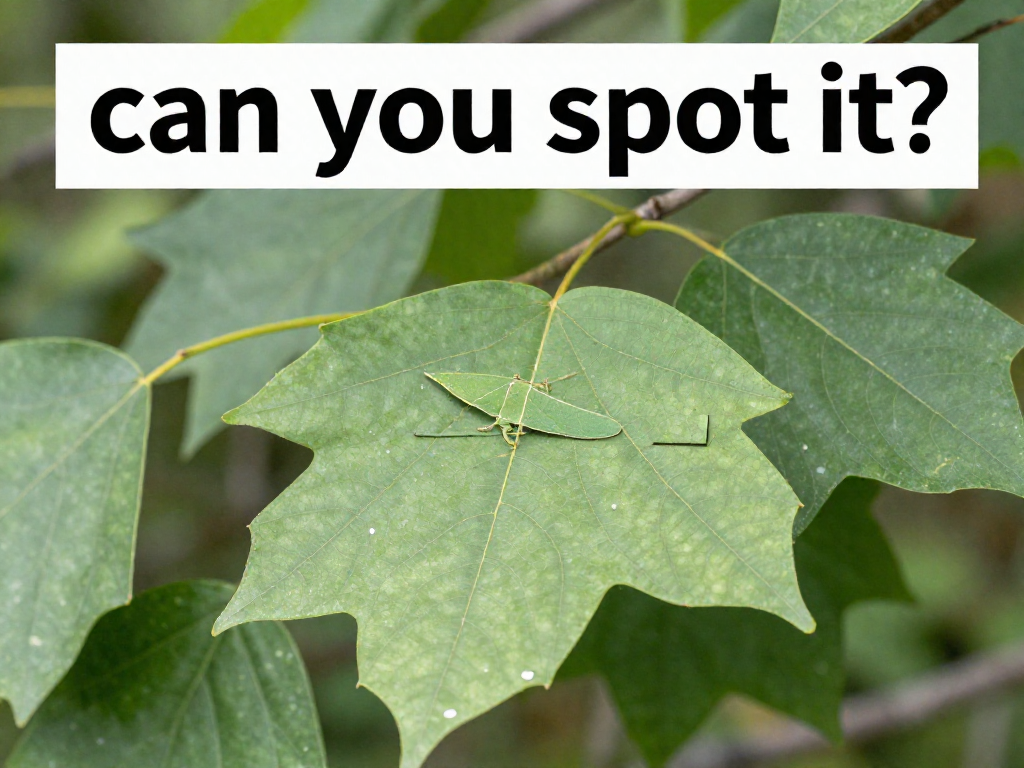
What Camouflage Really Means (It's More Than Just Blending In)
Some animals can vanish in plain sight while you're staring right at them — and color is only part of the trick. Camouflage is any adaptation that helps an animal avoid being detected or recognized, and it's a lot sneakier than "matching the background."
Here's the surprise: camouflage isn't one skill, it's a whole toolkit. An animal might fool the eye with color, but also with pattern, body shape, posture, the way it moves (or freezes), and in some cases even scent.
It also works in two directions:
- Hide from predators — so a hungry hawk or fox simply never spots dinner.
- Sneak up on prey — so a hunter gets close before anything notices.
Same goal in both cases: don't get recognized.
Throughout this article we'll explore the main types in action, including:
- Background matching — blending into surroundings
- Disruptive coloration — bold patterns that break up an outline
- Mimicry — looking like something else entirely (a leaf, a twig, or a more dangerous animal)
- Countershading — light underside, dark top, to flatten an animal's 3-D shape
Once you know what to look for, you'll start spotting these tricks everywhere.
Background Matching: The Classic Disappearing Act
A snowshoe hare can sit in plain sight three feet away and you'd still walk right past it. That's background matching—the most common camouflage trick in nature, where an animal's color and texture mimic its surroundings so closely it seems to vanish.
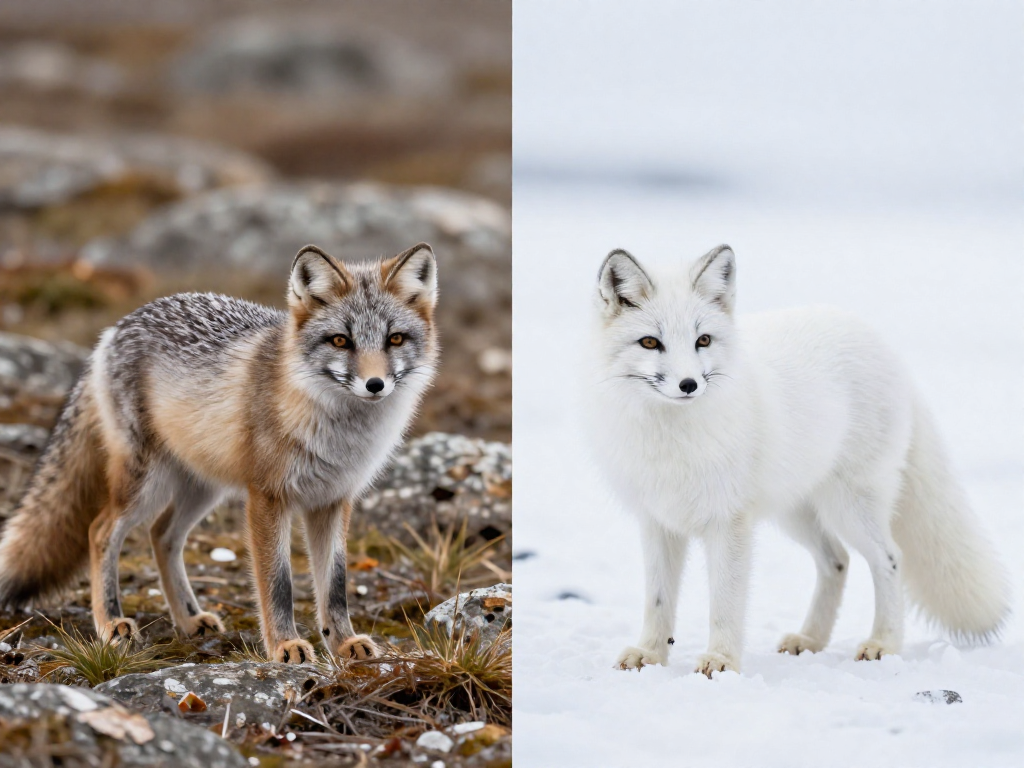
The idea is simple: the better an animal blends with its backdrop, the less it stands out. An arctic fox wears thick white fur against snow. A stick insect isn't just brown—its body has ridges, bumps, and even fake leaf scars that match real twigs. A flounder can shift its skin pattern to mirror the sandy or pebbly seafloor beneath it. And the snowshoe hare swaps its brown summer coat for snowy white in winter, then changes back as the seasons turn.
So why does this fool a hungry predator? Most hunters spot prey by detecting contrast—the difference between an object and its background, like a dark shape against a pale field. When an animal's color and texture match what's behind it, that contrast nearly disappears, and the predator's eyes have nothing obvious to lock onto. No sharp edge, no telltale outline, no meal.
But there's a catch: background matching only works in the right place. That same white arctic fox would stick out like a lightbulb on bare brown ground. This is exactly why the snowshoe hare changes coats with the seasons—and why a warming climate, where snow arrives late, can leave it mismatched and dangerously easy to spot.
Color-Changing Masters: Octopus, Cuttlefish & Chameleons
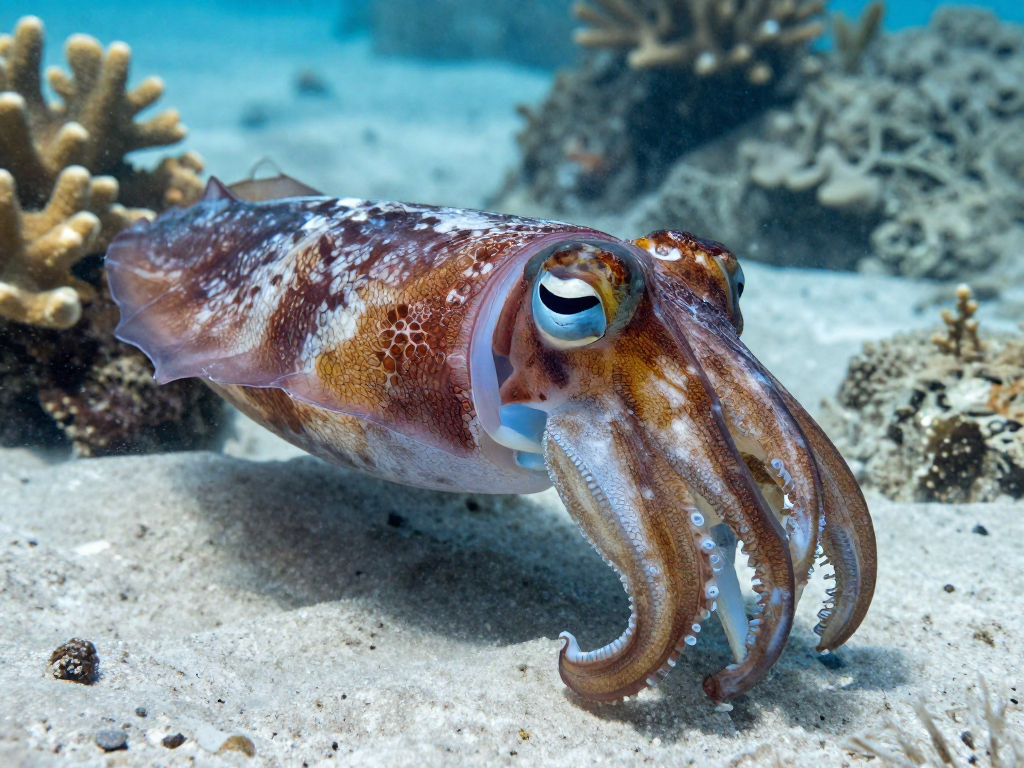
Imagine matching your shirt to the couch you're sitting on—in less than a second, without even glancing down. That's everyday life for an octopus. These animals pull off the flashiest trick in the camouflage world: active color change, where the disguise updates in real time instead of staying fixed like a moth's painted wings.
How Cephalopods Pull It Off
Octopuses, cuttlefish, and squid (together called cephalopods) layer three kinds of specialized skin cells:
- Chromatophores — tiny elastic sacs of pigment (red, yellow, brown, black) that muscles stretch open or pinch shut to flash color in milliseconds.
- Iridophores — reflective cells that bounce light to create blues, greens, and shimmering metallic sheens.
- Leucophores — white cells that scatter all wavelengths, helping match the brightness of the background.
Working together, these let a cuttlefish redraw its entire body pattern faster than you can blink.
The Colorblind Twist
Here's the part that stumps scientists: most octopuses and cuttlefish are colorblind—their eyes have just one type of light-detecting cell, so they technically can't see color the way we do. Yet they match colorful backgrounds with eerie precision. One leading idea, explored by researchers including Alexander Stubbs, is that their oddly shaped pupils may split incoming light to sense color indirectly. The mystery isn't fully solved, which is exactly why it's so cool.
Myth-Buster: The Chameleon Surprise
Chameleons get all the credit, but they're not mainly hiding. Research published in Nature Communications (2015) showed they shift color largely to regulate temperature (darkening to absorb heat) and to communicate—a stressed or showing-off male can blaze bright as a warning or a flirt. Blending in is a side benefit, not the main event.
So when people say "you're like a chameleon," the truer compliment might be "you're like an octopus"—a real-time master of disguise.
Disruptive Coloration: Breaking Up the Body Outline
Here's a twist that sounds backwards: sometimes the boldest pattern hides an animal best. A zebra's loud black-and-white stripes seem like the opposite of camouflage—yet they're a textbook example of disruptive coloration (markings that break up the body's recognizable outline rather than matching the background).
Why does this work? Predators don't scan for "a zebra." They look for a familiar shape—the curve of a back, the line of a leg, the silhouette of a head. High-contrast stripes and patches slice that shape into confusing chunks, so the brain struggles to assemble one solid animal. The edges that give away "prey here" simply dissolve.
You see the same trick across very different species:
- Zebras – stripes blur the herd into a shifting mass of lines, making any single animal hard to single out.
- Tigers – vertical stripes break up their form against tall grass and dappled light.
- Ringed plovers – bands across the head and chest split up the bird's outline on pebbly shorelines.
- Military camouflage – armies borrowed this idea directly, using bold, irregular patches instead of plain green.
Disruptive patterns can fool motion detection, too. Researchers studying zebra stripes have suggested the busy pattern may confuse a predator's sense of speed and direction as the animal moves—though scientists still debate exactly how much this helps.
The big takeaway: hiding isn't always about disappearing. Sometimes it's about looking like nothing in particular.
Mimicry: Pretending to Be Something Else
Some animals don't just hide—they cosplay. Instead of melting into the background, a mimic looks like a specific object or creature, fooling predators into thinking it's a leaf, a twig, or something far too dangerous to eat.
Pretending to be an object. Leaf insects (family Phylliidae) have flattened, vein-patterned bodies and even fake "bite marks" along the edges. Dead-leaf butterflies like the Indian Kallima fold their wings to reveal a perfect dried leaf, complete with a fake midrib. Some inchworm caterpillars hold themselves stiff and angled to pass for a bare twig.
Pretending to be dangerous. This is called Batesian mimicry (a harmless species copying a dangerous one). Many flower flies (hoverflies) wear bold yellow-and-black stripes so birds mistake them for stinging wasps—yet they can't sting at all. The viceroy butterfly was long considered a classic Batesian mimic of the toxic monarch, though research now suggests viceroys are also unpalatable, making it closer to Müllerian mimicry (two genuinely defended species sharing a warning look).
Misdirection with fake parts. Eyespots—large eye-like circles—can startle a predator or trick it into striking a non-vital area. Some hairstreak butterflies have a "false head" near their tail, complete with fake antennae, so a bird's bite removes a chunk of wing instead of the real head.
The all-in-one act. The Indo-Pacific mimic octopus (Thaumoctopus mimicus) takes this furthest. By changing color and contorting its arms, it can impersonate several animals—flattening into a venomous sole, trailing its arms like a banded sea snake, or splaying out like a spiny lionfish—reportedly switching disguises depending on the threat nearby.
Blending in says "you can't see me." Mimicry says "you don't want to."
Countershading & Other Clever Tricks
Some animals don't just match their background—they erase their own shadow. That's the secret behind countershading, one of nature's most widespread disguises.
The trick is simple. Sunlight hits an animal from above, lighting its top and casting a shadow on its belly, which makes its 3D shape pop out to a predator's eye. Countershaded animals flip the script: they're dark on top and pale underneath. The two tones cancel each other out, flattening the body so it seems to vanish. You'll spot this on sharks, deer, and penguins (whose dark backs blend with the ocean from above and white bellies blend with bright sky from below).
Other animals take stealth even further:
- Going see-through. Many jellyfish and glass frogs are partly transparent—you can spot a glass frog's beating heart right through its skin—so light passes through instead of bouncing back.
- Acting the part. Behavior matters as much as color. Stick insects sway like leaves in a breeze, and decorator crabs glue bits of seaweed, sponge, and shell onto their shells to become walking disguises.
- Glowing to hide. In the deep sea, some fish and squid use counter-illumination—tiny light-producing organs on their bellies that match the faint glow from the surface, hiding their silhouette from hunters lurking below.
Camouflage, it turns out, is a whole toolkit—not a single trick.
Why Camouflage Matters: The Evolutionary Arms Race
Here's the wild part: camouflage isn't a finished invention—it's a contest that never ends. Predators and prey are locked in an evolutionary arms race, each side slowly out-adapting the other across thousands of generations.
It works like a slow-motion competition. When a predator's eyesight gets a little sharper, the sneakier-looking prey are the ones that survive to have babies—so the next generation hides a little better. Then the predators that spot those tougher targets eat well and pass on their genes. Round and round it goes, with no finish line.
Humans borrowed these tricks, too:
- Military camo echoes disruptive coloration—patterns that break up an outline so the eye can't lock on.
- Biomimicry (designing technology by copying nature) has inspired everything from adaptive fabrics to color-shifting materials modeled on octopus and cuttlefish skin.
So the next time you walk through a forest or peer into a tide pool, remember: the most successful camouflage is the animal you never noticed at all—still there, perfectly hidden, winning the oldest game on Earth.
See also
- How Octopuses Are Smarter Than You Think
- Animal Superpowers: Creatures With Real-Life Sixth Senses
- Why Zebras Have Stripes (The Answer Surprised Scientists)
- Deep-Sea Animals That Glow in the Dark
Related articles
How Do Spiders Make Silk? The Chemistry Behind Nature's Strongest Fiber
How do spiders produce silk, and what makes it so strong?
Jul 28, 2026 · 10 min read
How Electric Eels Generate Shocks: A Deep Dive into Nature’s Living Batteries
How do electric eels produce electricity?
Jul 28, 2026 · 10 min read
Why Don't Woodpeckers Get Headaches? The Built-In Shock Absorbers
How do woodpeckers avoid brain injury despite repeated hammering?
Jul 20, 2026 · 6 min read