Super Senses: How Animals See, Hear, and Smell Better Than Us
Which animal senses far outperform human senses and how?
On this page
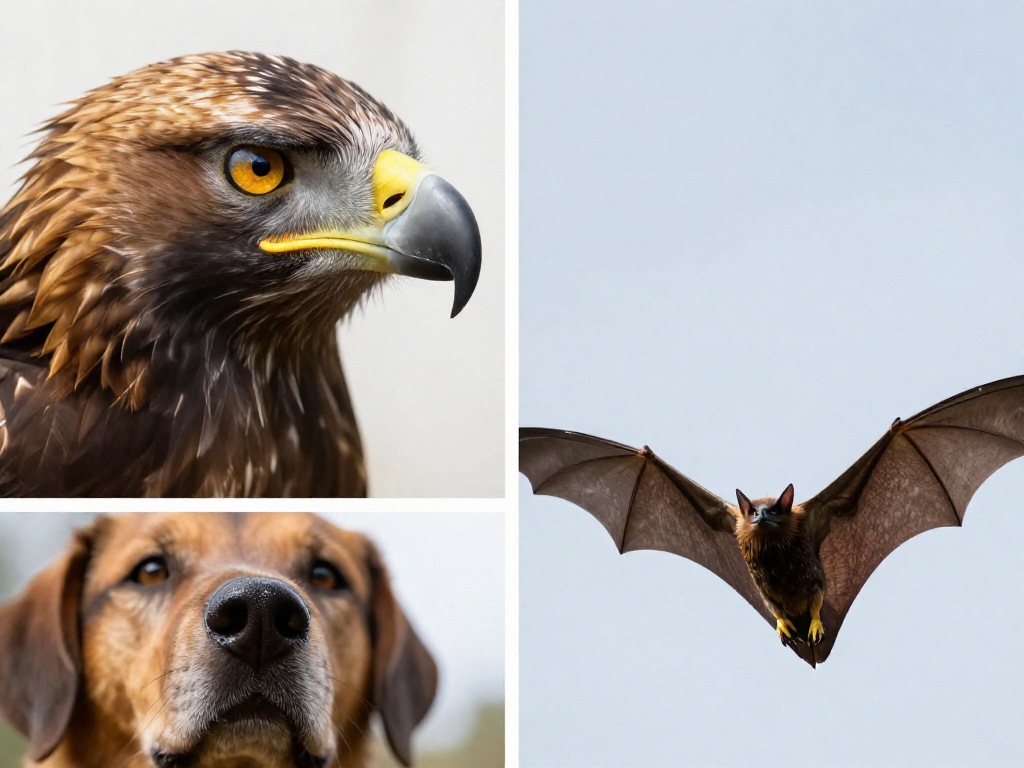
Why Animal Senses Beat Ours (The Quick Version)
Here's the humbling truth: your senses are gloriously, reliably average. A bloodhound can smell a scent trail days old, a mantis shrimp sees colors we can't even imagine, and an owl hears a mouse's heartbeat under snow—while we squint at a menu in dim lighting. We're not broken. We're generalists.
Humans are jacks-of-all-senses, masters of none. We see decent color, hear a useful range, and smell well enough to enjoy coffee. But "decent at everything" means "elite at nothing." Evolution didn't build us to win sensory contests; it built us to get by across many situations.
Other animals went the opposite way. Each species' senses are fine-tuned to one job: finding food, dodging predators, or surviving a specific habitat. A shark's super-smell suits hunting in vast, murky oceans. A bat's hearing fits a life of flying blind in the dark. The "upgrade" always matches the lifestyle.
That leads to the key reframe for this whole article: "better" rarely means simply "stronger." It usually means tuned to a different job than ours. An animal isn't beating us at our own game—it's playing a completely different one.
In the sections ahead, we'll explore four sensory superpowers:
- Sight — eyes built for darkness, distance, and invisible colors
- Hearing — ears that map the world in sound
- Smell — noses that read the air like a newspaper
- "Exotic" senses — abilities humans don't have at all
Ready to feel wonderfully outclassed? Let's dive in.
Super Sight: Animals That See What We Can't
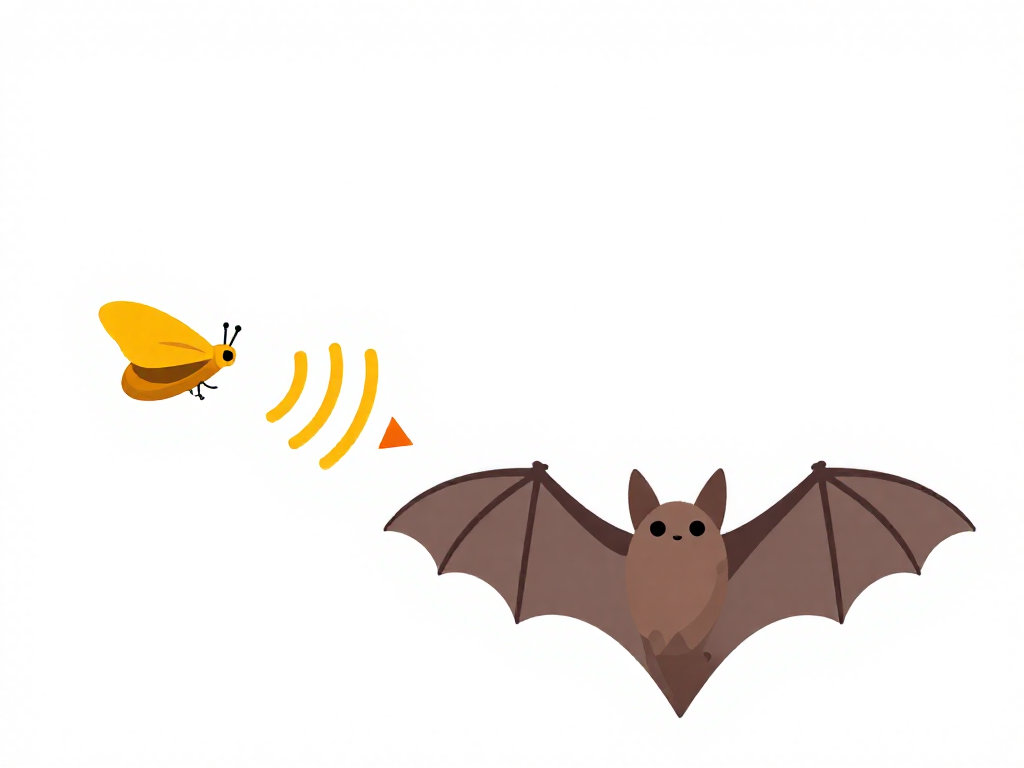
Imagine reading a newspaper headline from the length of a football field, or watching a flower glow with secret patterns invisible to everyone around you. For some animals, that's just an ordinary Tuesday. While human eyes are impressive, the animal kingdom has us beat on nearly every measure of vision—sharpness, night vision, color, and even how much of the world they can see at once.
Sharpness: The Eagle Eye Is Real
Eagles can see roughly 4 to 8 times more sharply than a person with perfect vision. The secret is in the retina (the light-sensing layer at the back of the eye), which is packed with far more light-detecting cells than ours—up to about a million per square millimeter in some birds of prey. That density lets an eagle spot a rabbit from over a mile away. It's the difference between a low-resolution photo and a crisp 4K image of the same scene.
Night Vision: Cats and Owls Own the Dark
Ever notice a cat's eyes glow in headlights? That's the tapetum lucidum (a mirror-like layer behind the retina) bouncing light back through the eye for a second chance to detect it. Combined with eyes loaded with rods (cells specialized for low light), cats can see in roughly one-sixth the light humans need. Owls take it further with huge, tube-shaped eyes that gather every available photon—perfect for hunting on a moonless night.
Color: The Mantis Shrimp's Wild Eyes
Humans see color using three types of receptors (cells tuned to red, green, and blue). The mantis shrimp has up to 16. That sounds like it should see unimaginable colors—but research suggests it doesn't blend them the way we do. Instead, it likely scans for specific colors quickly, like a barcode reader, which may help it react fast in busy coral reefs.
Ultraviolet: A Whole Hidden Layer
Bees, many birds, and even reindeer can see ultraviolet (UV) light, a part of the spectrum invisible to us. Flowers display UV "landing strips" that guide bees to nectar, and reindeer use UV vision to spot lichen and predators against Arctic snow.
Field of View: Seeing All Around
Sharpness isn't everything. Prey animals like rabbits and deer have eyes on the sides of their heads for a nearly 360-degree view, helping them catch danger from any direction. Chameleons go even further, swiveling each eye independently to watch two things at once—a genuine superpower for survival.
Super Hearing: Sounds Beyond the Human Range
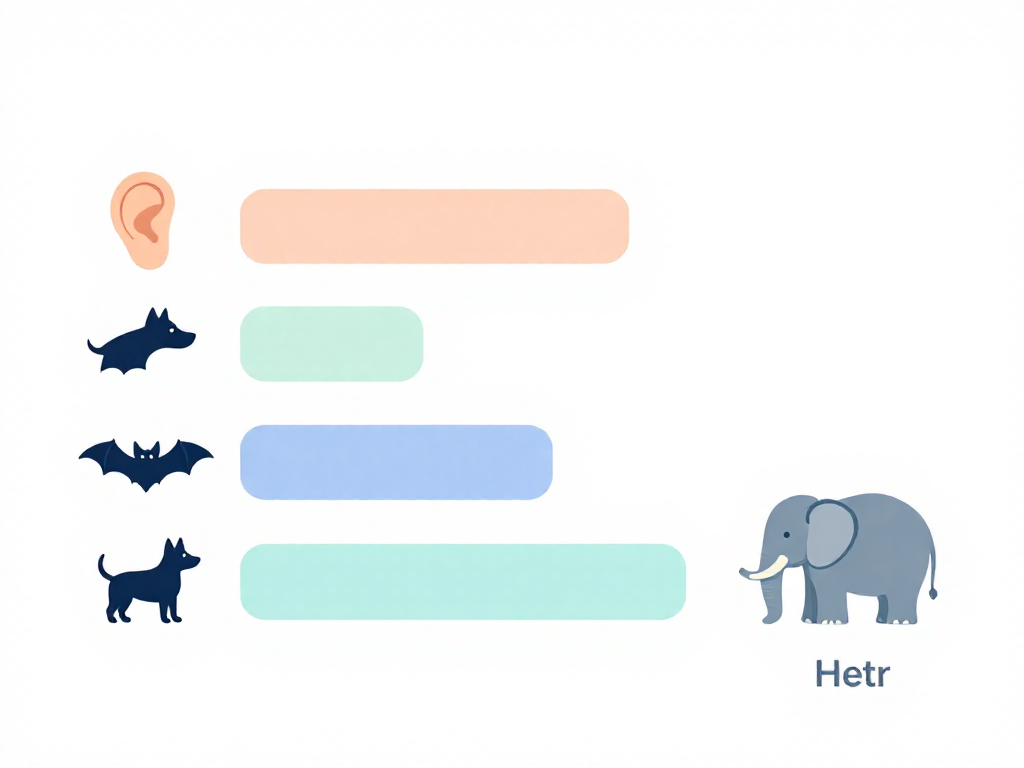
An elephant can "hear" a rainstorm from miles away—through its feet. While you're stuck inside a narrow window of sound, much of the animal kingdom is listening to a world you'll never notice.
Humans typically hear from about 20 Hz to 20 kHz (Hz means sound waves per second; higher numbers sound higher-pitched). That's a decent range, but it's the middle of the dial. Plenty of animals tune in far above and far below us—and their ear hardware is built for it.
Up high: the ultrasonic crowd
Anything above 20 kHz is ultrasound—too high for us to hear.
- Dogs hear up to roughly 45 kHz, and cats to about 64 kHz, which is why "silent" dog whistles work and why your cat hears mice squeaking in the walls. Both also swivel their ears like little satellite dishes to pinpoint exactly where a sound came from.
- Bats and dolphins take it further with echolocation—they make high-pitched calls and listen for the echoes to map their surroundings. Some bats produce calls above 100 kHz, building a "sound picture" precise enough to snag an insect in midair, in total darkness.
Down low: the infrasound network
Below 20 Hz is infrasound—too low and deep for human ears. Low frequencies have a superpower: they travel enormous distances without fading.
- Elephants rumble at frequencies as low as ~14 Hz and pick up these vibrations through the ground via sensitive feet and trunks, coordinating across miles of savanna.
- Whales use low-frequency calls that can carry across vast stretches of ocean, letting them stay in contact with others far beyond sight.
The owl's secret: lopsided ears
Many owls have ear openings set at different heights on each side of the head. A sound reaches one ear a split second before the other, and the brain uses that tiny gap to map the source in three dimensions—up, down, left, and right. The result: a barn owl can strike a mouse in complete darkness using hearing alone.
The takeaway? Hearing isn't one fixed ability—it's a toolkit, and evolution handed each species exactly the version it needed to survive.
Super Smell: The Champion Sense
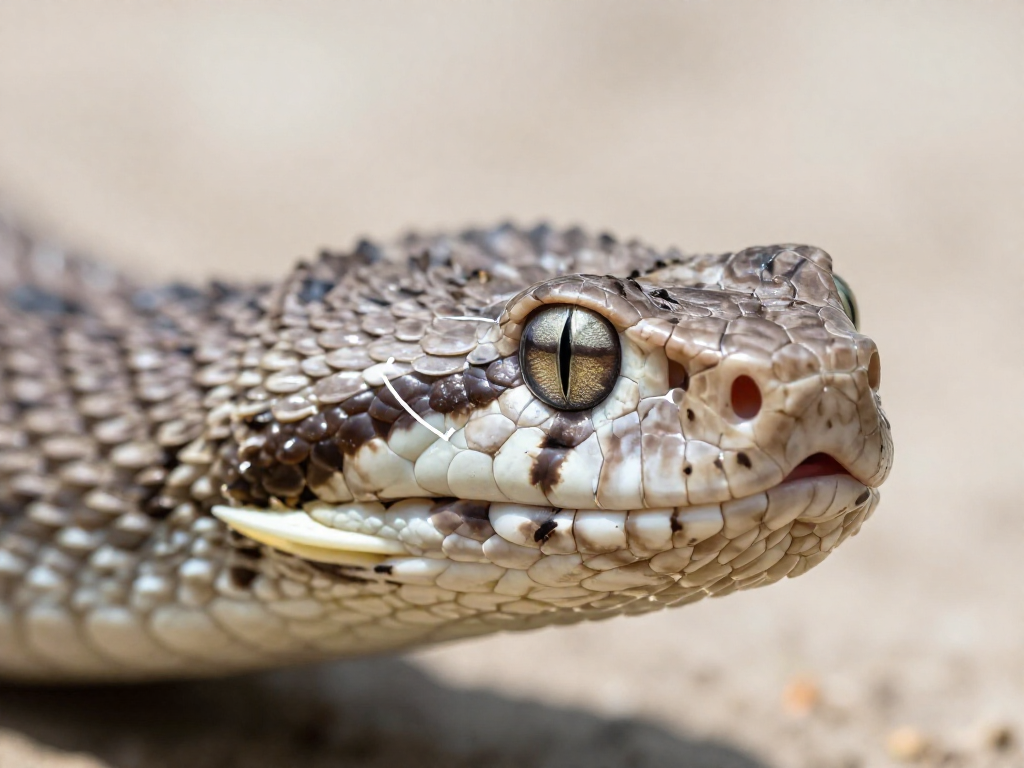
A bloodhound can pick up a scent trail that's been sitting for days, and a polar bear can reportedly smell a seal from miles away across the ice. If sight and hearing are impressive, smell is where the animal kingdom truly leaves us in the dust.
Take the dog, the poster child for super smell. While humans have roughly 6 million scent receptors in our noses, dogs have up to 300 million, depending on the breed. They also devote a far larger share of their brain to analyzing odors, which is why a dog "reads" a fire hydrant the way we read a newspaper—full of news about who passed by and when.
Smelling with the roof of the mouth. Many animals have a second scent tool: the vomeronasal organ (also called Jacobson's organ, a patch of sensory cells in the roof of the mouth). It's why a snake flicks its forked tongue—it's collecting scent particles from the air and pressing them against this organ to "taste-smell" its surroundings. The forked shape even helps it sense which direction a scent is coming from.
Tracking over distance and through water. Out in the wild, smell becomes a survival superpower:
- Bears have one of the keenest noses of any land animal—a grizzly's sense of smell is often estimated to be many times sharper than a bloodhound's, helping them locate food across vast territory.
- Sharks can detect certain substances dissolved in seawater at extremely low concentrations, letting them follow a scent plume toward its source.
- Elephants may take the crown: a genetic study found African elephants have around 2,000 olfactory (smell-related) genes—roughly twice as many as dogs and about five times more than humans, the most of any animal studied so far.
So why did evolution invest so heavily in smell? Because for many species it does triple duty. A scent trail is a map for navigation, a memory that links places and individuals across time, and a message board for communication—marking territory, finding mates, and signaling danger. What looks to us like a quick sniff is often an entire conversation.
The takeaway: when it comes to smell, we're not even in the same league. Animals don't just detect more odors than we do—they live in a rich, layered world of scent we can barely imagine.
Exotic Senses Humans Don't Have At All
Some animals don't just have sharper versions of our senses—they have senses we can't even imagine. Imagine "seeing" with sound, feeling the electric crackle of a hidden heartbeat, or sensing the planet's magnetic field like a built-in compass. These are real, and they're some of the strangest superpowers in nature.
Echolocation: Seeing With Sound
Bats and dolphins map their world using echolocation (sending out sound and reading the echoes that bounce back). A bat can pinpoint a moth in total darkness, and some species detect objects as thin as a human hair. Dolphins fire clicks through the water and "hear" the shape, distance, and even the insides of objects—their echolocation is precise enough to tell a golf ball from a ping-pong ball yards away.
Electroreception: Feeling Electric Fields
Every living body gives off faint electrical signals when muscles move. Sharks pick these up through tiny jelly-filled pores on their snouts called the ampullae of Lorenzini (electricity-sensing organs), letting them find a fish hiding under sand. The platypus takes it further: it hunts with its eyes, ears, and nostrils shut, relying entirely on electroreceptors and touch sensors in its bill to detect the twitching muscles of prey underwater.
Magnetoreception: A Built-In Compass
Birds, sea turtles, and salmon can sense Earth's magnetic field and use it to navigate across thousands of miles. Loggerhead sea turtles hatch on a beach, swim into the open ocean, and years later return to nearly the same spot—using the magnetic "address" of their birthplace. Migrating songbirds appear to detect the field through special proteins in their eyes, meaning they may literally see a compass overlaid on the world.
Infrared "Heat Vision"
Pit vipers like rattlesnakes have heat-sensing pits between their eyes and nostrils that detect infrared (the warmth radiating from a body). This lets a snake "see" the heat signature of a mouse in pitch darkness and strike with deadly accuracy—essentially a natural version of a thermal camera.
Vibration and Pressure Sensing
Many animals read the world through tiny movements. Spiders feel the faintest tremor of struggling prey through their web, distinguishing dinner from a stray leaf. Fish have a lateral line—a row of pressure-sensing organs along their bodies—that detects water currents and movement, helping a school turn as one and dodge predators without ever bumping into each other.
Quick takeaway: From sound-maps to electric fields to magnetic compasses, these senses prove that other animals experience entirely different versions of reality than we do.
How Do Scientists Actually Measure This?
Here's the twist: scientists can't just ask a dog how strong a scent smells. So how do we know any of this? Two big approaches do the heavy lifting.
The first is behavioral testing—training an animal to respond when it detects something (a sound, a color, a smell), then dialing that signal down until it can't react anymore. The second is physiology: counting sensory receptors (the detector cells in eyes, ears, and noses) and studying brain regions to see how much "wiring" is devoted to each sense.
But here's an important caveat. Those eye-catching "mantis shrimp sees 16 colors!" headlines? Behavioral tests actually showed mantis shrimp are surprisingly poor at distinguishing close colors, despite having up to 16 types of color receptors (we have 3). Having the hardware doesn't always mean the experience matches.
That's the honest limit of this science. Human comparisons—"40 times better smell"—are careful estimates, not exact readings. And we can never truly know what it feels like to be a bat or a bloodhound. We measure what animals can detect and respond to, then make our best, evidence-based guess about the rest.
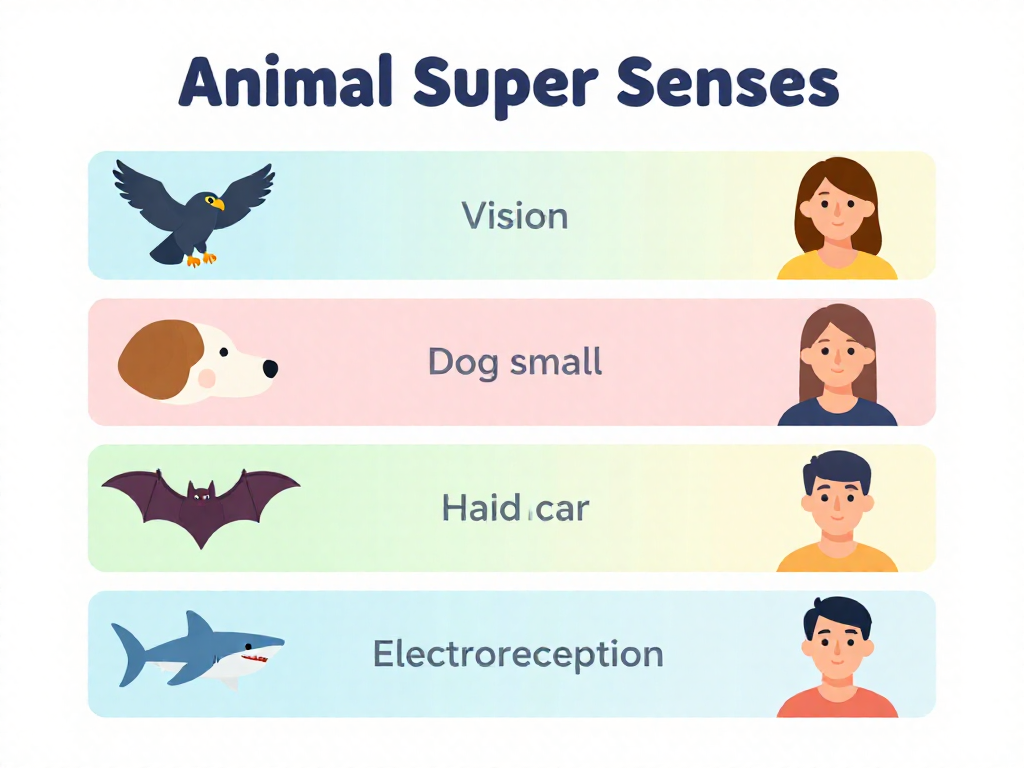
Quick Comparison: Animal Senses vs. Human Senses
Save this one for later: here's the whole article in a single skimmable cheat sheet. Each row shows the sense, the animal that crushes it, and exactly how it stacks up against us.
| Sense | Champion Animal | How It Beats Humans |
|---|---|---|
| 👁️ Sight | Eagle | Spots prey from up to ~2 miles away; sees roughly 4–8x sharper than a human with 20/20 vision. |
| 👂 Hearing (high) | Bat | Hears ultrasound up to ~200 kHz; humans top out near 20 kHz, so bats catch sounds 10x higher than we can. |
| 🐘 Hearing (low) | Elephant | Communicates in infrasound (deep rumbles below human range) that travels miles through the ground. |
| 👃 Smell | Dog | Up to ~300 million scent receptors vs. our ~6 million — a sense of smell tens of thousands of times sharper. |
| 🦈 Electric sense | Shark | Detects the faint electrical fields of hidden prey using special pores (electroreception). |
| 🐢 Magnetic sense | Sea Turtle | Reads Earth's magnetic field like a built-in GPS to navigate thousands of miles back home. |
Bottom line: no single animal wins every category — each is a specialist tuned to survive in its own world.
Pin or screenshot this graphic to share the super-senses showdown.
See also
- Animal Superpowers category hub
- How Bats Use Echolocation to 'See' in the Dark
- Why Dogs' Noses Are So Powerful
- Animals That Can See in the Dark
- How Sea Turtles Navigate Thousands of Miles Home
Related articles
How Do Spiders Make Silk? The Chemistry Behind Nature's Strongest Fiber
How do spiders produce silk, and what makes it so strong?
Jul 28, 2026 · 10 min read
How Electric Eels Generate Shocks: A Deep Dive into Nature’s Living Batteries
How do electric eels produce electricity?
Jul 28, 2026 · 10 min read
Why Don't Woodpeckers Get Headaches? The Built-In Shock Absorbers
How do woodpeckers avoid brain injury despite repeated hammering?
Jul 20, 2026 · 6 min read